Guide to Qualifying New Suppliers in Malaysia for Manufacturing Success
Malaysia is a premier manufacturing hub in Southeast Asia. According to the Malaysian Investment Development Authority (MIDA), “Malaysia, with its extensive trade....

By AMREP | Posted on November 16, 2026
Published: November 16, 2026
The APQP process is a structured framework that takes a new part from concept to stable mass production through five phases: Plan and Define the Program, Product Design and Development, Process Design and Development, Product and Process Validation, and Feedback, Assessment, and Corrective Action. Each phase ends with a gate review. Before the program moves forward, the team must show the outputs that gate requires.
This guide covers what each phase requires, the deliverables auditors expect at each gate, what changed in the 2024 AIAG 3rd Edition, and how to run APQP when your supplier sits in another country.
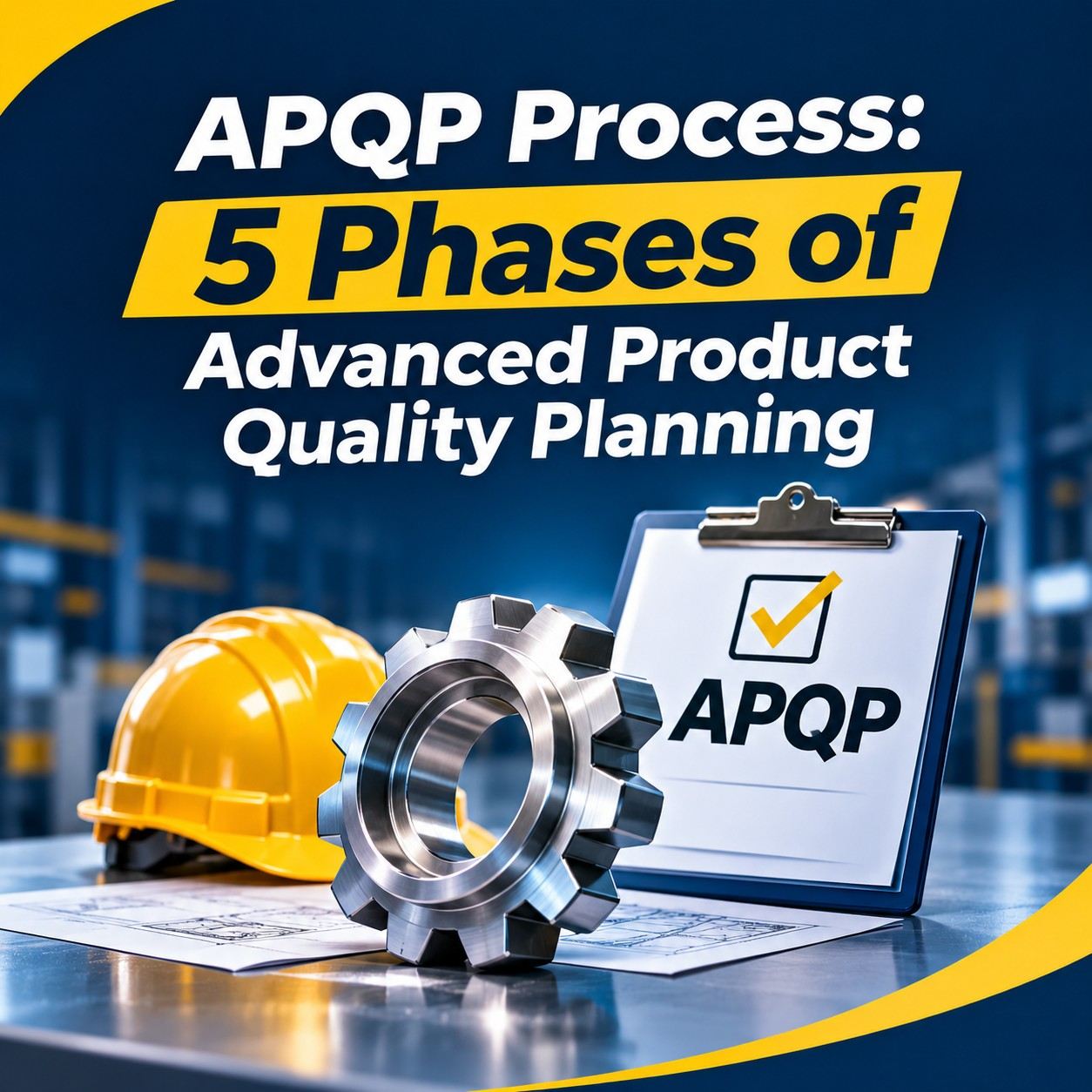
Advanced Product Quality Planning (APQP) is a cross-functional method for planning quality into a product before production starts. Ford, General Motors, and Chrysler developed it with the Automotive Industry Action Group (AIAG), which published the first reference manual in 1994. The second edition followed in 2008, and the third edition was released in March 2024.
The core idea is prevention. APQP doesn’t find defects at final inspection. It asks the team to identify risks early, design controls for them, and prove that those controls work before the customer receives a single production part.
APQP is one of the AIAG Core Tools, along with:
APQP is the umbrella that schedules when each of the other tools is used and what it must produce.
Design and process decisions get more expensive to change the further a program moves. A tolerance change before tooling is a drawing revision. The same change after tooling is cut can mean new steel, revalidation, and a delayed launch. APQP puts the hard questions at the stages where answering them is still cheap.
For automotive suppliers, APQP is effectively mandatory. IATF 16949 clause 8.3.2.1 names AIAG APQP as an example of the multidisciplinary approach required for design and development planning. Clause 8.3.4.4 requires a product approval process, which in practice means PPAP. Ford, GM, and Stellantis each publish customer-specific requirements that build on these clauses.
Outside automotive, APQP is used widely in aerospace (often alongside AS9145, the aerospace APQP and PPAP standard), medical devices, heavy equipment, electronics, and industrial products. Wherever a buyer needs proof that a supplier can produce conforming parts at volume, some form of APQP applies, even if the program calls it new product introduction (NPI) or stage-gate development.
AIAG published the APQP 3rd Edition and a standalone Control Plan 1st Edition on March 1, 2024. GM and Stellantis required suppliers to implement them by September 1, 2024, and Ford by December 31, 2024. Teams still working from 2008 training materials are out of date.
Changes that affect day-to-day planning:
The sub-tier requirement has the biggest operational effect. If your Tier 1 supplier buys castings from a foundry in another country, the foundry’s process planning is now part of your APQP evidence trail.
APQP moves a product through five sequential phases, and each one closes with a gate review where the team must show finished outputs before the next phase can begin. The phases below explain what each stage requires, which documents it produces, and where programs most often fall short.
Phase 1 turns what the customer wants into measurable design and quality targets. It sets the scope of the whole program, so errors made here carry through every later phase.
Reliability goals must be measurable. “High durability” isn’t a goal. “No functional failure after 500 thermal cycles from minus 40°C to 125°C” is. Vague targets in Phase 1 cause arguments in Phase 4, when validation results have nothing to be judged against.
Phase 1 is also where sourcing risk gets assessed. If a new supplier will make the part, check their capability and quality system before the design is locked. A supplier audit before sourcing costs far less than finding out in Phase 4 that the supplier can’t hold the tolerances.
Phase 2 develops the design and proves that it meets the Phase 1 targets. The design-responsible party leads, which may be the OEM or the supplier depending on the contract.
The team feasibility commitment is the most underrated document in APQP. It is the manufacturing team’s formal statement that the design can be produced at the required volume, cost, and quality. A supplier that signs it without real analysis, just to win the business, is signing up for problems at launch.
Ask suppliers to back each feasibility answer with evidence: capability data from similar parts, tooling quotes, and named equipment. To score failure modes before tooling is ordered, use a structured FMEA risk analysis.
Build-to-print suppliers sometimes assume Phase 2 doesn’t apply to them. IATF 16949 allows only product design to be excluded. Manufacturing process design can’t be excluded, so the feasibility commitment and the special characteristics list still belong to the supplier.
Phase 3 designs the manufacturing system that will make the product. The focus shifts from “does the part work” to “can we make it the same way every time.”
The process flow chart, PFMEA, and control plan must share the same operation numbers and describe the same steps. Auditors trace one characteristic from the drawing, through the flow chart, into the PFMEA, and onto the control plan. If the trail breaks anywhere, the documents were written separately instead of as one system.
The pre-launch control plan should be tighter than the production plan. Higher sampling rates, extra inspections, and added verification steps are normal until capability is proven. The structure of a well-built manufacturing control plan applies directly here.
Packaging is often treated as an afterthought, but damage in transit counts as a quality failure. For ocean freight from Asia or long truck routes from Mexico, the packaging specification should cover humidity, stacking load, vibration, and corrosion protection. Validate it with a real shipment, not only a desk review.
Phase 4 proves, with production tooling, gauges, operators, and cycle times, that the process makes conforming parts at the quoted rate. This is the phase that produces the PPAP submission.
Under the AIAG PPAP manual, the run must use production tooling, gauges, materials, operators, environment, and cycle time. The default quantity is 300 consecutive parts, unless the customer specifies otherwise. A run made by the best operator on day shift, at a slower cycle time, doesn’t count.
The AIAG PPAP manual sets these default thresholds for preliminary capability on special characteristics:
For measurement systems, AIAG MSA guidance treats gauge R&R under 10% as acceptable. Results from 10% to 30% may be acceptable depending on the application and cost, and results over 30% are unacceptable. Customer-specific requirements can tighten these limits.
Run MSA before the capability study. A gauge with 35% GRR makes any Ppk value meaningless, because the measurement noise is mixed into the process variation. To see how preliminary and ongoing capability differ, read this explanation of Ppk vs Cpk capability.
PPAP isn’t a separate project. It packages the evidence created across all four phases: design records, FMEAs, control plan, MSA, capability studies, dimensional results, and the Part Submission Warrant. If APQP was done well, assembling the PPAP is administrative work. If it was rushed, PPAP turns into a scramble. This guide to the Production Part Approval Process covers the 18 elements and five submission levels.
Phase 5 starts at launch and runs for the life of the part. Its purpose is to reduce variation, improve delivery and customer satisfaction, and capture lessons learned for the next program.
Under the 3rd Edition approach, the extra Safe Launch controls stay in place until defined exit criteria are met. These are often a set number of shipments with zero defects, or a run of stable capability data. Write the exit criteria down before launch. Without them, temporary controls either stay forever and add cost, or get removed early when production pressure builds.
Lessons learned only help if someone uses them. Link every customer complaint and internal nonconformance to the PFMEA line that should have predicted it. If the failure mode wasn’t in the PFMEA, add it, and add it to the generic PFMEA for the next similar part too.
| Phase | Core Question | Key Deliverables | Gate Evidence |
|---|---|---|---|
| 1. Plan and Define | What exactly must we deliver? | Design goals, reliability goals, preliminary BOM, preliminary flow chart, special characteristics list | Signed program scope and measurable targets |
| 2. Product Design | Does the design meet the targets? | DFMEA, DVP&R, drawings, specifications, prototype control plan, feasibility commitment | Design verification results and signed feasibility |
| 3. Process Design | Can we build it consistently? | Process flow, PFMEA, pre-launch control plan, floor layout, MSA plan, packaging spec | Linked flow chart, PFMEA, and control plan |
| 4. Validation | Does the real process prove it? | Significant production run, MSA results, Ppk studies, PPAP, production control plan | Approved PSW and customer sign-off |
| 5. Feedback | Is it staying stable and improving? | SPC trends, scorecards, corrective actions, lessons learned | Safe Launch exit and ongoing KPIs |
Each core tool has a defined place in the APQP timeline:
These tools depend on each other. A high-severity failure mode in the PFMEA should show up as a control on the control plan. That control should use a gauge that passed MSA, and the characteristic should be watched with SPC. If any link is missing, the system has a gap.
APQP also overlaps with broader new product introduction programs. Many companies run APQP inside their NPI stage gates, using APQP outputs as the quality criteria for each gate.
APQP was written for suppliers a short drive from the customer’s engineering team. Supply chains now run through Mexico, Vietnam, Thailand, Malaysia, India, and China, and that distance adds risks the reference manual doesn’t fully address.
The PFMEA and control plan are often written in English for the customer, while work instructions on the floor are in Spanish, Vietnamese, or Thai. Check that the translated instructions match the current control plan revision. A control plan at revision D with floor instructions at revision B is a common finding.
Remote review of PPAP documents can’t confirm that the significant production run used production conditions. Having an engineer on site during the run-at-rate checks cycle time, operator staffing, tooling, and gauge use firsthand. This is where local supplier quality engineering support pays off.
Gauges used for MSA should have calibration traceable to a national standard, through a lab accredited to ISO/IEC 17025. In some regions, certificates come from labs without valid accreditation. Check the accreditation scope, not just the certificate.
The 3rd Edition expects you to review sub-tier APQP activity. Ask the supplier to list every sub-supplier of special characteristic features: raw material, heat treat, plating, and coatings. Then confirm that each one has its own process controls. Weak sub-tier suppliers can be brought up to standard through structured supplier development programs.
Schedule gate reviews in a time slot where both engineering teams can join live. Gate reviews done by email lose the discussion that brings out unresolved risks.
These patterns come up often in supplier quality work:
Each of these leaves the paperwork looking complete while the process stays unproven. The result is usually a quality problem in the first 90 days after launch, often followed by a nonconformance report and corrective action cycle that a full APQP would have prevented.
A gate review is a decision meeting, not a status update. Use this structure:
The 3rd Edition added APQP program metrics. Track at least the percentage of deliverables completed on time at each gate and the number of open actions carried into the next phase. Rising carry-forward counts are an early warning that launch will slip or launch quality will suffer. Ongoing production quality management keeps those metrics visible after launch.
Timing follows the customer’s program schedule, not a fixed duration. A simple carryover component may finish all five phases in a few months. A new safety-critical assembly with new tooling can take well over a year. The control point is the gate dates the customer sets, so build your APQP timeline backward from the required PPAP date.
Yes, at a scaled level. A design or process change triggers the phases it affects. A new material, for example, needs updated DFMEA and PFMEA, new validation testing, and usually a PPAP resubmission. The 3rd Edition added specific change management guidance for this situation.
The customer may grant interim approval, usually with conditions such as 100% inspection of the affected characteristic, a corrective action plan, and a date for a new capability study. Without that approval, parts can’t ship as production material.
Usually yes, if the forms capture all the required content. Some OEMs require their own portal or templates, so check the customer-specific requirements before building your document set.
The supplier owns its APQP deliverables. The customer remains responsible for verifying them, and under the 3rd Edition, so does any Tier 1 sourcing from sub-tiers. Many buyers use in-country quality engineers to witness key activities and confirm the evidence on site.
APQP isn’t legally required outside automotive, but aerospace uses AS9145, and medical device makers apply similar planning under ISO 13485 design controls. The five-phase logic carries over to any industry with high-volume production and strict quality requirements.
APQP works when every phase produces real evidence instead of paperwork, and when someone checks that evidence where the parts are actually made. AMREP Inspect supports manufacturers across Mexico, Vietnam, Thailand, Malaysia, and other Asian manufacturing regions with on-site quality engineers. They can audit supplier readiness in Phase 1, witness run-at-rate trials in Phase 4, and track launch performance in Phase 5. To plan support for your next program launch, contact the AMREP Inspect team or explore our automotive supplier quality services.
Contact Us To See What We Can Do
Call Us
Mon - Sat 9.00 - 18.00
Sunday Closed

12 - May 2025
12
May
2025
Malaysia is a premier manufacturing hub in Southeast Asia. According to the Malaysian Investment Development Authority (MIDA), “Malaysia, with its extensive trade....

22 - April 2025
22
April
2025
Healthcare is rapidly evolving, ensuring consistent and high-quality patient care. Total Quality Management (TQM) in healthcare is more than just a buzzword—it is a powerful....
16 - April 2025
16
April
2025
Total Quality Management (TQM) is a mindset that involves everyone in the organization working toward a common goal: achieving excellence through quality. From....


Our website uses cookies to improve your experience. Read our Cookie Policy for more information.