Guide to Qualifying New Suppliers in Malaysia for Manufacturing Success
Malaysia is a premier manufacturing hub in Southeast Asia. According to the Malaysian Investment Development Authority (MIDA), “Malaysia, with its extensive trade....

By AMREP | Posted on January 16, 2026
In the Philippines, AQL (Acceptable Quality Limit) sampling, guided by ISO 2859 standards, helps reduce manufacturing defects through statistical sampling rather than 100% inspection. It defines maximum acceptable defect levels for minor, major, and critical issues within a production batch. This approach saves inspection costs while ensuring consistent product quality through systematic and repeatable checks.
By identifying quality issues early, AQL sampling helps Filipino manufacturers and exporters meet global standards, reduce rework and returns, and improve customer satisfaction. It is widely used across industries to support reliable production and successful international trade.
This article outlines how AQL sampling and ISO 2859 are applied in Philippine manufacturing to reduce defects.
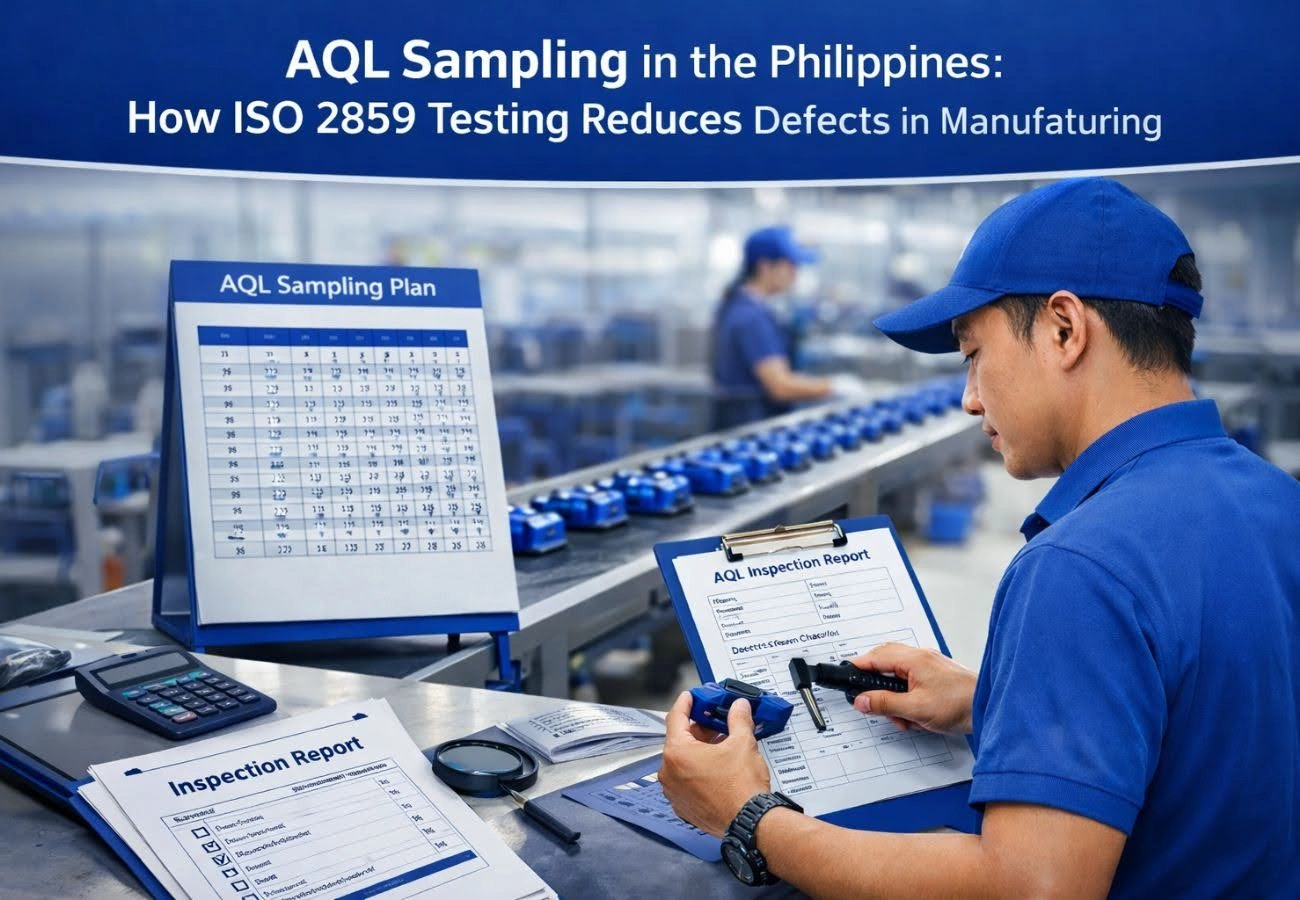
AQL, or Acceptable Quality Limit, is a statistical measurement that defines the maximum number of defective items considered acceptable in a production batch. It does not mean defects are acceptable; rather, it sets a tolerance threshold for quality risk.
AQL sampling is used during inspections to determine whether a shipment should be accepted or rejected based on the number and severity of defects found in a randomly selected sample.
Instead of checking 100% of products, which is often impractical and expensive, inspectors examine a representative sample that reflects the overall production quality.
In the Philippines, AQL sampling is commonly used during pre-shipment inspections, during production checks, and final random inspections.
ISO 2859 is the international standard that governs AQL sampling procedures. It defines how samples are selected, the number of units to be inspected, and how inspection results are evaluated.
ISO 2859 is equivalent to the ANSI/ASQ Z1.4 standard used in the United States. Both follow the same principles and tables, making them globally interchangeable.
By using ISO 2859, buyers sourcing from the Philippines ensure inspections are fair, repeatable, and aligned with global quality expectations.
The Philippines has a diverse manufacturing sector, encompassing everything from high-precision electronics to labour-intensive garments and handcrafted furniture. Each industry has different quality risks, making a structured inspection approach essential.
AQL sampling helps importers maintain consistent quality while managing costs and timelines.
By applying ISO 2859 sampling, these issues can be detected early and managed before shipment.
AQL sampling follows a structured process defined by ISO 2859. Each step is critical to ensuring inspection accuracy and reliability.
The lot size refers to the total number of units in the production batch or shipment. This could be the total quantity in one purchase order, container, or shipment.
The lot size determines how many samples will be selected for inspection.
ISO 2859 defines several inspection levels, which control sample size.
In the Philippines, General Inspection Level II is the default for most pre-shipment inspections unless otherwise specified by the buyer.
Using ISO 2859 sampling tables, inspectors determine the sample size based on the lot size and inspection level.
For example:
This ensures the sample is statistically representative of the entire batch.
Defects are classified into three categories:
Defects that pose safety risks or violate regulations. These are not acceptable under any circumstances.
Examples:
Defects that affect product function, performance, or appearance and would likely result in customer complaints or returns.
Examples:
Defects that do not affect function but deviate from specifications or appearance standards.
Examples:
Each defect category has its own AQL value. Common AQL settings used in the Philippines include:
Inspectors compare the number of defects found in the sample against ISO 2859 acceptance and rejection limits.
If defect counts exceed the allowed limit, the shipment fails inspection.
AQL sampling does more than just detect defects; it actively improves manufacturing quality over time. In practice, ISO 2859 helps reduce manufacturing defects through the following key mechanisms.
When suppliers know inspections are based on ISO 2859 standards, they are more likely to maintain consistent quality throughout production. Repeated inspection failures create pressure to improve internal processes.
Patterns in inspection results often reveal deeper production problems, such as:
Early detection allows corrective action before defects multiply.
Finding defects before shipment is far less expensive than dealing with returns, recalls, or customer complaints in destination markets.
AQL sampling helps stop defective goods before they leave the factory.
100% inspection is rarely practical for large-scale manufacturing. AQL sampling provides a scientifically balanced approach that controls risk without slowing production or increasing costs excessively.
In the Philippines, AQL sampling is most commonly applied during pre-shipment inspections. This final check ensures the finished goods meet buyer requirements before shipment approval.
During PSI, inspectors use AQL sampling to assess:
The inspection outcome determines whether the shipment is approved, rejected, or requires corrective action.
AQL sampling is also used during during-production inspections (DPI). These inspections take place when 20–60% of production is complete.
Using AQL during production helps:
This approach is especially useful for high-volume or complex products.
Despite its advantages, AQL sampling has several limitations outlined below.
AQL is a risk-based system. It reduces the probability of defects but does not eliminate them.
For products with strict safety or regulatory requirements, AQL sampling should be combined with:
Incorrect sampling methods, biased selection, or misclassification of defects can compromise inspection accuracy. This is why experienced inspectors are essential.
To get reliable results from AQL sampling, it must be applied correctly and consistently. When used as part of a structured quality control strategy, AQL helps reduce defects and improve supplier performance over time.
Below are the best practices that importers and manufacturers should follow when using AQL sampling in the Philippines.
Always define the inspection level before production or inspection begins. General Inspection Level II is the most commonly used and provides a good balance between risk and cost. Higher inspection levels may be required for complex or high-risk products.
Clearly agree on AQL limits for critical, major, and minor defects with your supplier. Common limits are 0 for critical defects, 2.5 for major defects, and 4.0 for minor defects. These limits should be stated in purchase orders or quality agreements.
Defect definitions must be clear and measurable. Vague descriptions lead to inconsistent inspection results and disputes. Use photos, samples, or written criteria to define what counts as critical, major, and minor defects.
Samples must be selected randomly across the entire batch. Avoid allowing suppliers to choose samples. Random selection ensures the inspection reflects actual production quality and prevents biased results.
AQL sampling works best when combined with other quality control activities, such as during-production inspections, factory audits, and laboratory testing. This layered approach reduces risk more effectively than relying on final inspection alone.
Conduct AQL inspections only when production is complete and goods are packed. Inspecting too early may result in unrepresentative samples and unreliable results.
Accurate AQL sampling depends on inspector expertise. Inspectors must understand ISO 2859 tables, defect classification, and product-specific requirements. Experienced inspectors reduce errors and improve report reliability.
Inspection results should not be treated as one-time pass or fail outcomes. Track defect trends across shipments and use the data to address root causes with suppliers. This leads to continuous quality improvement.
AQL sampling based on ISO 2859 is an effective way to reduce manufacturing defects and control quality risks in the Philippines. By applying statistical sampling and clear defect limits, businesses can ensure consistent quality without the cost of full inspection.
AMREP Inspect delivers reliable quality inspection services, including AQL sampling and ISO 2859 inspections, to help manufacturers and importers catch issues early and meet global quality standards.
Partner with AMREP Inspect today to protect your shipments and improve product quality with confidence.
Contact Us To See What We Can Do
Call Us
Mon - Sat 9.00 - 18.00
Sunday Closed


12 - May 2025
12
May
2025
Malaysia is a premier manufacturing hub in Southeast Asia. According to the Malaysian Investment Development Authority (MIDA), “Malaysia, with its extensive trade....

22 - April 2025
22
April
2025
Healthcare is rapidly evolving, ensuring consistent and high-quality patient care. Total Quality Management (TQM) in healthcare is more than just a buzzword—it is a powerful....

16 - April 2025
16
April
2025
Total Quality Management (TQM) is a mindset that involves everyone in the organization working toward a common goal: achieving excellence through quality. From....


Our website uses cookies to improve your experience. Read our Cookie Policy for more information.