By AMREP | Posted on February 16, 2026
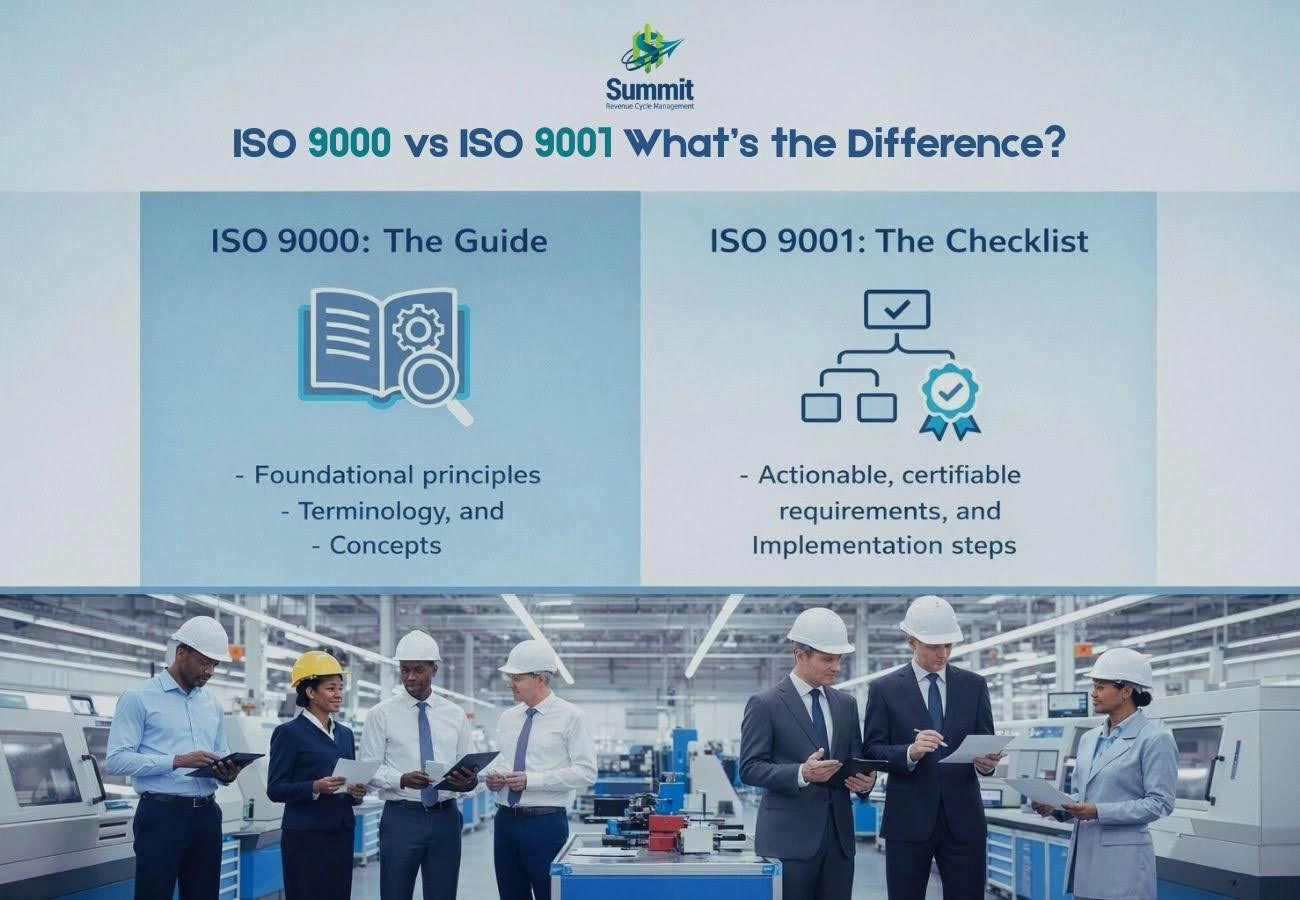
In the world of quality management, ISO 9000 and ISO 9001 are closely related but serve different
purposes. ISO 9000 lays the foundation, defining the principles, terminology, and concepts behind a
Quality Management System (QMS), while ISO 9001 translates those concepts into actionable, certifiable
requirements. Simply, ISO 9000 is the guide, and ISO 9001 is the checklist for implementing and
maintaining quality across your organization.
This guide provides a practical comparison of ISO 9000 and ISO 9001 to help businesses understand their
purpose and how to apply them effectively.
Understanding ISO Standards
The International Organization for Standardization (ISO) develops globally recognized standards
across industries. ISO standards ensure products, services, and processes meet consistent
quality, safety, and efficiency benchmarks. For quality management specifically, the ISO 9000
family is the most relevant.
Key Points About ISO 9000 Family
- Provides frameworks and principles for quality management systems (QMS).
- Widely recognized internationally across manufacturing, service, and technology sectors.
- Includes multiple standards: ISO 9000, ISO 9001, ISO 9004, and others.
- Helps organizations build customer trust, improve operational efficiency, and achieve
compliance.
What is ISO 9000?
ISO 9000 is the foundational standard in the ISO 9000 family and serves as the starting point for
understanding quality management systems. Unlike ISO 9001, ISO 9000 cannot be certified, but it
provides essential guidance for organizations looking to implement a QMS effectively.
Purpose of ISO 9000
- Define Quality Concepts: Explains key terms such as quality, process, nonconformity,
corrective action, and continual improvement.
- Introduce Quality Principles: Lays out the principles that guide effective quality
management, including:
- Customer focus
- Leadership and commitment
- Engagement of people
- Process approach
- Improvement
- Evidence-based decision-making
- Relationship management
- Provide a Reference Framework: Acts as a guide to help organizations understand the
“why”
behind quality processes before implementing them.
Key Features
- Terminology Guide: Establishes a common language across all departments, from production
to
quality assurance.
- Principles for Management: Offers best-practice guidance to create a culture of
quality
throughout the organization.
- Educational Resource: Ideal for training employees and preparing teams before ISO
9001
implementation.
Certification:
- ISO 9000 cannot be certified. It is informational and provides foundational knowledge for
ISO 9001.
Practical Example for Manufacturers
A manufacturing company might use ISO 9000 to train production and QA staff on the definitions of
nonconformities, the importance of process-based thinking, and the principles of continual
improvement. This ensures that when ISO 9001 requirements are implemented, everyone speaks the
same “quality language” and understands the rationale behind each process.
What is ISO 9001?
ISO 9001 is the certifiable standard in the ISO 9000 family. While ISO 9000 provides the concepts
and terminology, ISO 9001 lays out specific, actionable requirements for implementing a Quality
Management System (QMS). Organizations can be audited against ISO 9001 and receive formal
certification, demonstrating their commitment to quality and customer satisfaction.
Purpose of ISO 9001
- Establish a Structured QMS: Provides a framework to control and improve processes
systematically.
- Ensure Consistent Product and Service Quality: Reduces defects, errors, and
variability in
manufacturing operations.
- Support Continual Improvement: Encourages organizations to monitor, measure, and
enhance
performance over time.
- Enable Certification: Offers a formal, recognized way to show compliance to
customers,
regulators, and partners.
Key Features
- Certifiable Requirements: Organizations must meet defined clauses (Clauses 1–10) to
achieve
ISO 9001 certification.
- Process Approach: Focuses on managing processes efficiently, rather than only
inspecting
finished products.
- Risk-Based Thinking: Requires identifying risks and opportunities in production,
purchasing,
inspection, and delivery.
- Performance Evaluation: Includes monitoring KPIs, conducting internal audits, and
reviewing
management processes.
Certification:
- Organizations can achieve ISO 9001 certification after external audit by a certified body.
- Certification demonstrates operational maturity and customer commitment
Practical Example for Manufacturers
A component manufacturer implementing ISO 9001 might:
- Standardize production processes with detailed SOPs and work instructions
- Track key metrics like scrap rates, machine downtime, and on-time delivery
- Conduct internal audits to ensure compliance
- Implement corrective actions for defects or process failures
Achieving ISO 9001 certification shows customers that the organization not only understands
quality management but also applies it systematically to deliver reliable products and services.
Key Differences Between ISO 9000 and ISO
9001
While ISO 9000 and ISO 9001 are closely related, they serve distinct roles within a quality
management system. Understanding these differences helps organizations know where to start and
how to implement an effective QMS.
| Feature |
ISO 9000 |
ISO 9001 |
| Purpose |
Provides definitions, principles, and guidance on QMS |
Provides certifiable requirements for implementing a QMS |
| Certifiable |
No |
Yes |
| Focus |
Understanding quality management concepts |
Operational implementation and continual improvement |
| Usage |
Training, reference, and foundation for ISO 9001 |
Certification, process control, audit compliance |
| Structure |
Explains principles and terminology |
Clauses 1–10 define specific QMS requirements |
| Target Audience |
Anyone seeking to understand quality management |
Organizations aiming for ISO 9001 certification |
| Outcome |
Knowledge and awareness |
Certified QMS with improved processes and customer confidence |
Practical Takeaway
- ISO 9000 is the “why” and the guide. It helps your team understand quality principles and
terminology.
- ISO 9001 is the “how” and the checklist. It lays out what your organization must do to
implement a QMS and achieve certification.
How ISO 9000 Supports ISO 9001
ISO 9000 and ISO 9001 work hand-in-hand. Understanding ISO 9000 helps organizations implement ISO
9001 more effectively and ensures everyone speaks the same quality language.
- Shared terminology: Reduces confusion when implementing ISO 9001.
- Understanding principles: Leaders and staff can internalize the 7 quality management
principles before applying them.
- Training foundation: ISO 9000 is excellent for onboarding employees in quality
awareness.
Practical Tip:
Many organizations first train their teams on ISO 9000 concepts before rolling out ISO 9001
processes. This ensures everyone understands the “why” behind the “how.”
Benefits of ISO 9001 Certification
Achieving ISO 9001 certification provides more than just a certificate on the wall. For
manufacturers and organizations across industries, it delivers tangible business benefits by
improving processes, reducing errors, and boosting customer confidence.
1. Consistent Product and Service Quality
- Standardized processes ensure that products meet specifications every time.
- Reduces variability in production, lowering scrap rates and rework.
2. Improved Customer Satisfaction
- Demonstrates a commitment to quality and reliability.
- Builds trust with clients and strengthens long-term relationships.
3. Operational Efficiency
- Streamlines workflows and eliminates unnecessary steps.
- Optimizes resource usage, including materials, equipment, and labor.
4. Risk Management
- Risk-based thinking helps identify potential process failures before they occur.
- Prevents costly downtime, defects, and customer complaints.
5. Competitive Advantage
- ISO 9001 certification is recognized globally and often required by clients or regulators.
- Opens access to new markets and business opportunities.
6. Continual Improvement
- The framework encourages regular monitoring, evaluation, and enhancement of processes.
- Promotes a culture of quality throughout the organization.
Practical Example for Manufacturers
A component manufacturer implementing ISO 9001 might:
- Reduce defective components by 30% through improved inspection and process control.
- Increase on-time delivery to 98% by standardizing production schedules and supplier
management.
- Build stronger client relationships by showing documented compliance with international
Implementing ISO 9001 Using ISO 9000
as a Guide
Step 1: Understand the Principles (ISO 9000)
- Train teams on customer focus, leadership, engagement of people, and process approach.
Step 2: Define Context and Scope (ISO 9001 Clause 4)
- Identify internal/external issues, stakeholders, and QMS boundaries.
Step 3: Develop Quality Policy and Objectives (ISO 9001 Clauses 5–6)
- Ensure alignment with business strategy and measurable targets.
Step 4: Provide Resources and Competence (ISO 9001 Clause 7)
- Train staff, maintain equipment, manage documentation, and communicate processes.
Step 5: Control Operations (ISO 9001 Clause 8)
- Standardize production, inspection, and supplier management.
Step 6: Monitor, Audit, and Review (ISO 9001 Clause 9)
- Track KPIs, conduct internal audits, and hold management reviews.
Step 7: Improve Continually (ISO 9001 Clause 10)
- Correct nonconformities, analyze root causes, and implement improvements.
Tip: Use ISO 9000 terminology as a common language during training,
documentation, and internal audits.
Common Misconceptions
Many organizations misunderstand the purpose and relationship of ISO 9000 and ISO 9001.
Clarifying these misconceptions helps ensure a smoother implementation and avoids wasted effort.
1. ISO 9000 is a Certification
- Misconception: ISO 9000 provides certification like ISO 9001.
- Reality: ISO 9000 is informational—it defines terminology and principles but cannot
be
certified.
2. ISO 9001 Guarantees Quality Products
- Misconception: Certification automatically ensures defect-free products.
- Reality: ISO 9001 ensures that processes are controlled and monitored, but product
quality
still depends on proper execution and management commitment.
3. ISO 9001 is Only for Manufacturers
- Misconception: Only factories and production companies need ISO 9001.
- Reality: Service organizations, IT companies, healthcare providers, and more can
implement
ISO 9001 to improve processes and customer satisfaction.
4. ISO 9000 is Optional for ISO 9001
- Misconception: You must implement ISO 9000 first.
- Reality: While not required, ISO 9000 is highly recommended as a knowledge foundation
to
understand ISO 9001 requirements.
5. Certification is the End Goal
- Misconception: Once ISO 9001 certification is achieved, the work is done.
- Reality: ISO 9001 is a framework for continual improvement, not a one-time
accomplishment.
Organizations must regularly monitor, audit, and improve their processes.
6. ISO 9001 is Just Paperwork
- Misconception: ISO 9001 is primarily about creating documents and SOPs.
- Reality: Documentation supports process control, but the focus is on actual process
performance, risk management, and continual improvement.
Choosing the Right Approach
Implementing ISO 9001 can be done in several ways, but selecting the right approach ensures
efficiency, reduces errors, and maximizes the benefits of your Quality Management System (QMS).
Using ISO 9000 as a guide can help manufacturers make informed decisions from the start.
- Top-Down vs. Bottom-Up: Combine leadership-driven vision with operator input for
practical
processes.
- Phased vs. Big-Bang: Start with critical processes first to manage change
effectively.
- In-House vs. Consultant-Led: Blend internal ownership with expert guidance for
faster,
smoother implementation.
- Align with Business Goals: Ensure QMS supports objectives like reducing defects,
improving
delivery, and boosting customer satisfaction.
Learn how to ensure quality and reliability by checking these 10
Things to Check Before Signing
with a New Manufacturer.
Practical Example: Manufacturer
Scenario
Company: ABC Industrial Components
Challenge: High scrap rates, inconsistent inspection practices, and customer
complaints.
Approach:
- Trained staff using ISO 9000 concepts.
- Mapped processes according to ISO 9001 requirements.
- Implemented risk-based planning, supplier audits, and inspection checkpoints.
Result:
- Scrap reduced by 25%
- On-time delivery improved to 98%
- Successfully achieved ISO 9001:2015 certification
Discover how your operations can improve by exploring the Benefits of
implementing Total Quality
Management (TQM).
Optimize Your QMS and Ensure Certification Success
with AMREP Inspect
Understanding the distinction between ISO 9000 and ISO 9001 is essential for any organization
seeking quality excellence. ISO 9000 provides the knowledge and foundation, while ISO 9001
delivers the structured, certifiable framework that drives consistent performance and customer
satisfaction.
Amrep Inspect offers end-to-end quality management
services, including ISO 9001 implementation,
gap analysis, internal audits, training, and ongoing process improvement support.
Contact Amrep Inspect today to streamline your ISO 9001 journey, enhance operational efficiency,
and elevate product quality.