Guide to Qualifying New Suppliers in Malaysia for Manufacturing Success
Malaysia is a premier manufacturing hub in Southeast Asia. According to the Malaysian Investment Development Authority (MIDA), “Malaysia, with its extensive trade....

By AMREP | Posted on December 28, 2025
Many organizations adopt Lean manufacturing to improve efficiency and reduce waste, yet struggle to achieve lasting results because they are unsure which Lean tools to use and how to apply them correctly. Lean tools such as Value Stream Mapping, 5S, Kaizen, Kanban, Standard Work, SMED, Poka-Yoke, Takt Time, and Gemba Walks provide practical methods for improving flow, quality, and consistency—but only when they are applied to the right problems.
This blog explains the most important Lean manufacturing tools, how each one works, and when to use them effectively in real-world operations.
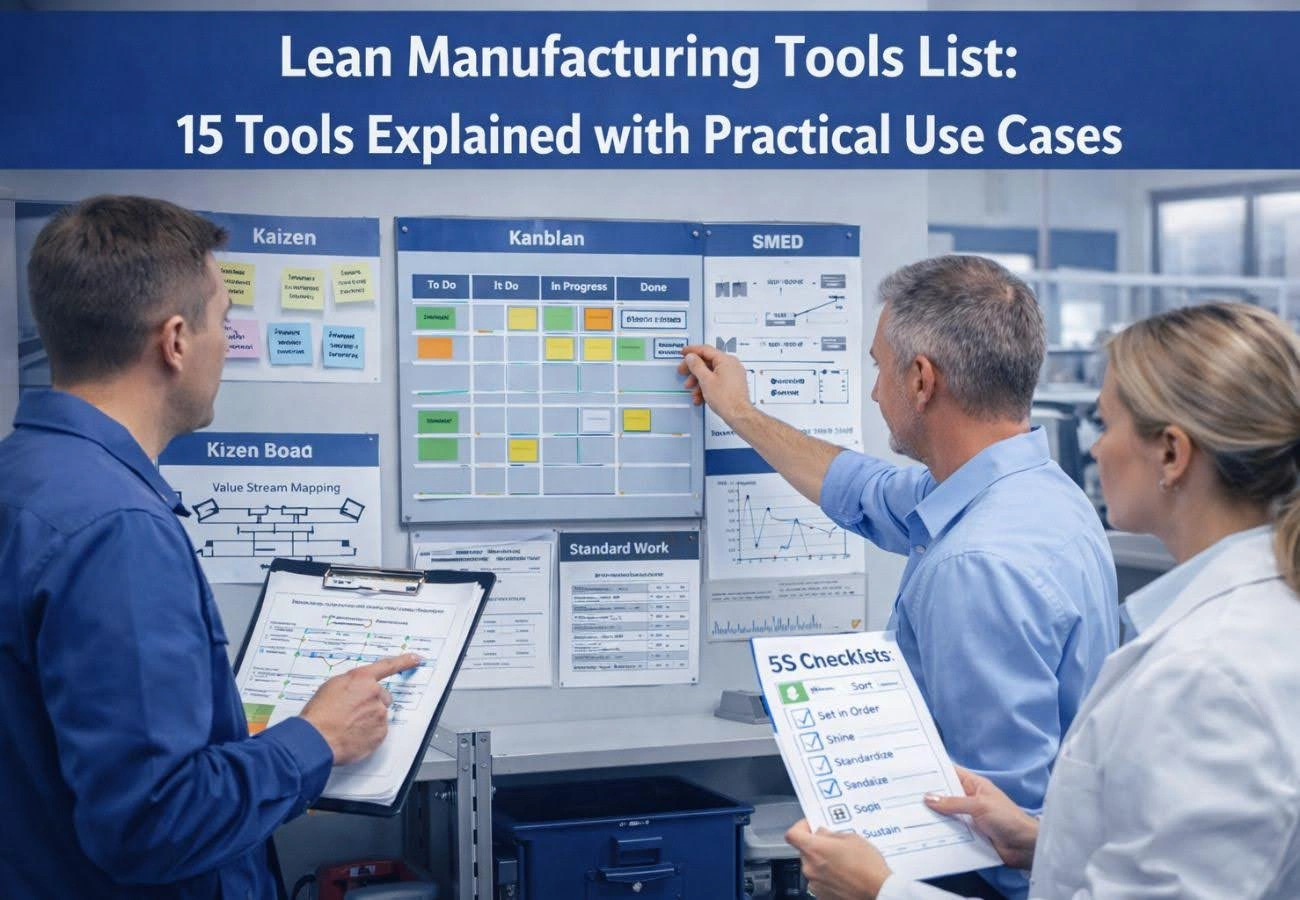
Lean manufacturing tools are structured methods and techniques used to identify waste, improve process flow, reduce variation, and support continuous improvement. They help teams move from assumptions to facts and from reactive firefighting to proactive control.
Lean tools are not stand-alone solutions. Their power comes from:
Lean manufacturing tools can be grouped into a few core categories based on the problems they address: flow, workplace stability, inventory control, quality, and continuous improvement. Understanding these categories helps teams select the right tool instead of applying Lean methods in isolation.
Below are the most widely used Lean manufacturing tools, explained one by one.
Value Stream Mapping is a visual tool that maps the entire end-to-end flow of materials and information required to deliver a product or service to the customer. It captures both value-added and non-value-added activities.
Purpose:
How it works:
Teams document the current state of the process, including process steps, cycle times, wait times, inventory levels, information flows, and handoffs. They then calculate total lead time versus value-added time and design a future-state map that removes waste and improves flow.
Practical example:
A manufacturer maps its order-to-shipment process and finds that although actual production takes only 2 days, total lead time is 40 days. The map reveals long waiting times between departments and excess inventory buffers, with only 5% of the time adding value.
Best used when:
5S is a workplace organization method that creates a clean, efficient, and standardized work environment.
Purpose:
How it works:
Unnecessary items are removed, tools are organized logically, work areas are cleaned, standards are defined, and routines are established to maintain improvements.
Practical example:
A machining area installs shadow boards and standardized tool locations, reducing tool search time by 40% and improving operator productivity.
Best used when:
Kaizen is a philosophy and structured approach focused on continuous, incremental improvement driven by employees.
Purpose:
How it works:
Teams regularly identify small problems, test improvements, and standardize successful changes. Kaizen events may be short, focused workshops targeting specific issues.
Practical example:
A team runs a 3-day Kaizen event to reduce machine changeover time by reorganizing tools and standardizing setup steps, achieving a 25% reduction.
Best used when:
Standard Work documents the best-known method for performing a task safely, efficiently, and consistently.
Purpose:
How it works:
It defines the work sequence, cycle time, and standard inventory required to complete a task.
Practical use case:
A production line reduces defect rates after defining standard work steps, cycle times, and work sequences.
Best used when:
Kanban is a visual pull system that controls inventory and workflow based on actual consumption.
Purpose:
How it works:
Signals such as cards, bins, or digital boards trigger replenishment only when materials are used.
Practical use case:
A supplier implements Kanban cards to replenish components only when consumed, reducing excess inventory by 30%.
Best used when:
JIT is a production strategy that delivers materials and products only when needed, in the required quantity.
Purpose:
How it works:
Production is scheduled based on demand, supported by stable processes and reliable suppliers.
Practical use case:
A factory shifts from monthly batch production to daily JIT scheduling, reducing lead time and storage costs.
Best used when:
Poka-Yoke design processes or devices that prevent errors or make them immediately obvious.
Purpose:
How it works:
Design features, fixtures, or controls ensure tasks are done correctly or stop the process when errors occur.
Practical use case:
A fixture is designed so that a part can only be loaded in the correct orientation, eliminating assembly errors.
Best used when:
Andon is a visual or audible alert system that signals process abnormalities.
Purpose:
How it works:
Operators activate an alert when issues arise, prompting immediate support and problem resolution.
Practical use case:
Operators pull an Andon cord when defects occur, triggering supervisor support and root cause analysis.
Best used when:
Takt time defines the pace of production needed to meet customer demand.
Purpose:
How it works:
Available production time is divided by customer demand to determine the required output rate.
Practical use case:
A line balances work elements to match takt time, reducing overtime and bottlenecks.
Best used when:
SMED is a method for reducing setup and changeover times.
Purpose:
How it works:
Setup tasks are separated into internal (machine stopped) and external (machine running) activities, then streamlined.
Practical use case:
A press line reduces changeover time from 90 minutes to 20 minutes by separating internal and external setup tasks.
Best used when:
Problem-solving tools that identify underlying causes rather than symptoms.
Purpose:
How it works:
Teams repeatedly ask “why” or map causes across categories to uncover root causes.
Practical use case:
A team uses 5 Whys to trace recurring defects to inconsistent training, not operator error.
Best used when:
Visual systems that communicate standards, performance, and status at a glance.
Purpose:
How it works:
Boards, charts, labels, and color-coding make information immediately visible.
Practical use case:
A production board shows daily targets vs. actual output, making issues visible at a glance.
Best used when:
Producing items one piece at a time rather than in batches.
Purpose:
How it works:
Processes are rearranged into cells that support uninterrupted movement of products.
Practical use case:
A cell redesign moves from batch processing to one-piece flow, cutting lead time in half.
Best used when:
Smoothing production volume and mix to reduce variability.
Purpose:
How it works:
Production schedules are smoothed to avoid peaks and valleys.
Practical use case:
A plant levels daily production across product families instead of running large, uneven batches.
Best used when:
Leaders observe work where it happens to understand processes firsthand.
Purpose:
How it works:
Managers regularly visit the shop floor to observe processes, ask questions, and support improvement.
Practical use case:
Managers conduct daily Gemba walks to identify safety hazards and process inefficiencies early.
Best used when:
For real-world examples of how Lean tools drive results, explore our Lean Manufacturing Case Studies – Successful Applications in the Workplace.
Not every tool fits every problem. Start by asking:
Lean works best when tools are used strategically, not mechanically.
While Lean tools are powerful when applied correctly, many organizations fail to achieve lasting results due to common implementation mistakes, including the following:
Treating Lean tools as one-time events
Implementing Lean tools as isolated projects or short-term initiatives instead of embedding them into daily operations leads to temporary gains that quickly fade.
Applying tools without employee involvement
Using Lean tools without engaging the people who perform the work often results in resistance, poor adoption, and solutions that do not reflect real process challenges.
Ignoring data and relying on opinions
Making improvement decisions based on assumptions or personal experience rather than facts and measurements undermines the effectiveness of Lean and leads to inconsistent results.
Failing to standardize and sustain improvements
Improvements that are not documented, standardized, and regularly reinforced tend to regress to old practices, eliminating long-term benefits.
Using tools without leadership support
Lean initiatives without visible leadership commitment lack direction, resources, and accountability, making sustained improvement difficult.
To learn how continuous improvement drives long-term performance gains, read our guide on Kaizen – Understanding How It’s Used to Improve Manufacturing Performance Continuously.
Lean manufacturing tools provide practical, proven methods for improving efficiency, quality, and customer value. When applied thoughtfully, they help organizations eliminate waste, strengthen processes, and build a culture of continuous improvement.
To support effective Lean implementation, AMREP Inspect delivers reliable quality inspection services that ensure accurate data, consistent execution, and compliance across your operations and supply chain. By partnering with AMREP Inspect, you gain the inspection confidence needed to support Lean decisions, prevent defects, and maintain high-quality standards.
Contact Us To See What We Can Do
Call Us
Mon - Sat 9.00 - 18.00
Sunday Closed

12 - May 2025
12
May
2025
Malaysia is a premier manufacturing hub in Southeast Asia. According to the Malaysian Investment Development Authority (MIDA), “Malaysia, with its extensive trade....
22 - April 2025
22
April
2025
Healthcare is rapidly evolving, ensuring consistent and high-quality patient care. Total Quality Management (TQM) in healthcare is more than just a buzzword—it is a powerful....
16 - April 2025
16
April
2025
Total Quality Management (TQM) is a mindset that involves everyone in the organization working toward a common goal: achieving excellence through quality. From....


Our website uses cookies to improve your experience. Read our Cookie Policy for more information.