Guide to Qualifying New Suppliers in Malaysia for Manufacturing Success
Malaysia is a premier manufacturing hub in Southeast Asia. According to the Malaysian Investment Development Authority (MIDA), “Malaysia, with its extensive trade....
By AMREP | Posted on August 28, 2026
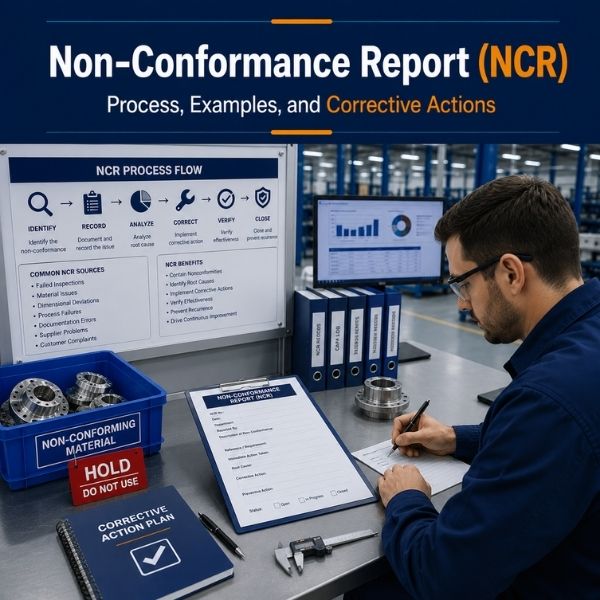
A Non-Conformance Report (NCR) is a formal quality record used to document a product, process, material, or service that does not meet a specified requirement. It records what went wrong, where and when the nonconformance occurred, what was affected, how the issue was contained, and what corrective action is required.
A well-managed NCR process does more than document defects. It helps contain nonconformities, identify root causes, implement corrective actions, verify effectiveness, and prevent recurrence.
NCRs can result from failed inspections, material issues, dimensional deviations, process failures, documentation errors, supplier problems, or customer complaints. Analyzing NCR data also helps identify recurring issues and improvement opportunities.
This guide explains what an NCR is, when to issue one, what it should contain, and how to complete the NCR process. It also covers real examples, root cause analysis, corrective actions, effectiveness verification, and best practices for managing nonconformances.
An NCR documents a gap between what was required and what was actually produced or delivered. It applies to:
The report itself is not the fix. It is the trigger that starts a structured response: containment, investigation, correction, and prevention.
When production happens thousands of miles from a buyer's engineering and quality teams, the NCR becomes the primary channel for communicating problems clearly and holding a supplier accountable. A well-written NCR does three things a phone call or email chain cannot:
Third-party inspectors working inside the factory catch nonconformances before goods leave the production line, which is far cheaper than catching them after they land at a warehouse or, worse, after a customer complaint. In practice, the buyers who get the most value from their NCR process are the ones who treat it as a shared problem-solving tool with the supplier, not a punitive paper trail. A supplier that trusts the process to be fair is more likely to report a problem early than to hide it and hope it isn't caught.
Nonconformances surface at several distinct points in the sourcing cycle, and where one is caught changes how much it costs to fix.
The earlier a nonconformance is caught in this sequence, the cheaper and faster it is to contain. A dimensional error caught during incoming inspection costs a rejected batch of raw material. The same error caught at final inspection costs a full production run, and if it is missed entirely, it costs a customer return or field failure.
Not every nonconformance carries the same risk, and NCRs should be classified so that the right level of urgency is applied.
| Classification | Definition | Typical Response |
|---|---|---|
| Critical | Creates a safety hazard or violates a legal/regulatory requirement | Immediate stop-ship, full containment, executive notification |
| Major | Product will likely fail in use or fails a specified requirement | Hold shipment pending disposition, root cause required |
| Minor | Cosmetic or documentation issue unlikely to affect function | Correct before shipment or note as a concession |
Classifying severity up front prevents two common failures: treating a critical defect as a paperwork formality, or halting an entire shipment over a scratch that has no functional impact.
A consistent, repeatable process is what separates a functioning quality system from a folder of disconnected complaint emails.
Skipping steps, especially root cause investigation and verification, is the single biggest reason nonconformances recur.
A usable NCR form should capture enough detail that anyone reading it later, without having been present, understands exactly what happened.
| Field | Purpose |
|---|---|
| NCR number | Unique identifier for tracking and reference |
| Date and location | When and where the deviation was found |
| Part/product identification | Part number, description, lot or batch number |
| Quantity affected | How much material is impacted |
| Requirement violated | The specification, drawing note, or standard clause |
| Description of the nonconformance | Objective, factual description of the deviation |
| Supporting evidence | Photos, measurement data, test results |
| Disposition | Use-as-is, rework, repair, sort, or scrap |
| Root cause | Underlying cause, not just the symptom |
| Corrective action plan | What will change, who owns it, and by when |
| Verification method and result | How effectiveness was confirmed |
| Sign-off | Names and dates of approvers on both sides |
Vague descriptions like "part is bad" or "doesn't match spec" are the most common weakness inspectors see. A useful NCR states the measured value against the required value, or shows a labeled photo comparing the defect to an approved sample.
The following anonymized examples are representative of nonconformances identified during AMREP field inspections at supplier facilities.
Final inspection of an automotive bracket found a mounting hole diameter measuring 8.3mm against a drawing requirement of 8.0mm ±0.1mm. The NCR documented the measurement against 30 sampled units, of which 12 were out of tolerance.
Disposition: 100% sort of the affected lot, with rework of a worn drill bushing identified as the root cause.
An incoming inspection of stainless steel fasteners found no mill test certificate accompanying the shipment, a requirement under the purchase order. The NCR held the lot at the supplier's warehouse pending certificate submission.
Root cause: a new logistics coordinator was unaware of the documentation requirement. Corrective action: certification checklist added to the shipping process, with a second sign-off step.
During container loading supervision, cartons were found without the moisture barrier bags specified in the packaging instructions for a coastal export route. The NCR stopped loading until barrier bags were applied to all affected cartons.
Root cause: packaging instructions were not translated into the language used on the factory floor.
A supplier substituted a lower-grade plastic resin mid-production run without submitting an engineering change request. The deviation was caught during in-process inspection when surface finish did not match the approved first article sample.
Disposition: full production hold, scrap of the affected run, and a corrective action requiring supplier sign-off on any material change before it reaches the line.
An in-process audit found that a supplier's caliper used for critical dimension checks had no current calibration sticker and was 47 days past its due date. Every part measured with that tool during the gap was flagged as suspect pending re-inspection.
Root cause: the supplier's calibration schedule was tracked on paper and the tool had been missed during a staff transition.
Corrective action: calibration tracking moved to a digital system with automated due-date alerts, and all suspect parts were re-measured with a verified tool before release.
These two documents are related but not interchangeable, and mixing them up creates confusion in supplier communication.
An NCR can exist without ever generating a CAR (a one-time, isolated event with an obvious, already-corrected cause). But any recurring or major nonconformance should trigger a CAR that goes deeper than the immediate incident.
The disposition and containment steps stop the bleeding. Root cause analysis and corrective action are what actually solve the problem.
Common root cause tools include:
A corrective action is only effective if it addresses the process, not just the individual part. For example, "we retrained the operator" fixes one person's behavior. "We added a fixture that makes it physically impossible to load the part backward" fixes the process itself and prevents recurrence regardless of who is on the line.
AMREP's manufacturing quality engineering team conducts thorough root cause analysis (RCA) to identify the source of quality issues and develop corrective and preventive actions (CAPA). The team then follows up to verify that the corrective actions remain effective during subsequent production runs.
Common mistakes can make an NCR less useful for both immediate containment and long-term supplier improvement. The following are the most frequent issues to avoid.
Tracking nonconformances across time matters more than any single report. A supplier who resolves an isolated dimensional issue is a very different risk than one who has raised the same NCR three times in six months. Without a running log tied to supplier and part number, that pattern is invisible until it becomes a customer-facing failure.
Catching a nonconformance after a container has left port can be expensive and difficult to fix. AMREP inspectors work inside the factory during production, not just at final inspection. This allows deviations to be identified and addressed before goods are shipped.
This on-the-ground presence supports the full NCR lifecycle. Containment can begin immediately because the inspector is physically present. Root cause discussions can happen directly with production and quality teams instead of through long email exchanges. Corrective actions can also be verified during the next production run, without waiting for the next scheduled inspection.
The supplier owns the corrective action and root cause investigation. The buyer or inspecting party verifies the fix and approves closure. Neither side closes an NCR unilaterally.
Until the corrective action has been verified as effective, typically on the next production run. There is no fixed timeline; closing early to hit a metric defeats the purpose.
Yes, through a documented use-as-is disposition with buyer approval, usually when the deviation has no functional or safety impact. This must be recorded on the NCR, not handled informally.
A deviation is a pre-approved, temporary departure from a requirement, agreed before production. A nonconformance is discovered after the fact and was not pre-approved.
Minor, isolated issues with an obvious cause may not need a full investigation. Major, critical, or recurring nonconformances always should.
Yes. A shared log by supplier and part number reveals recurrence patterns a single NCR can't show, and that history is what should inform decisions on re-sourcing or supplier probation.
Consistent, well-documented NCRs turn scattered supplier problems into a searchable quality history, and that history is what makes root cause trends visible before they become recurring costs. AMREP Quality Inspection Services place inspectors directly on the factory floor in China, Vietnam, Malaysia, Thailand, and Mexico, catching nonconformances during production and driving supplier corrective actions to verified closure. Contact us to build an NCR process that actually prevents repeat defects.
Contact Us To See What We Can Do
Call Us
Mon - Sat 9.00 - 18.00
Sunday Closed


12 - May 2025
12
May
2025
Malaysia is a premier manufacturing hub in Southeast Asia. According to the Malaysian Investment Development Authority (MIDA), “Malaysia, with its extensive trade....

22 - April 2025
22
April
2025
Healthcare is rapidly evolving, ensuring consistent and high-quality patient care. Total Quality Management (TQM) in healthcare is more than just a buzzword—it is a powerful....
16 - April 2025
16
April
2025
Total Quality Management (TQM) is a mindset that involves everyone in the organization working toward a common goal: achieving excellence through quality. From....


Our website uses cookies to improve your experience. Read our Cookie Policy for more information.