Guide to Qualifying New Suppliers in Malaysia for Manufacturing Success
Malaysia is a premier manufacturing hub in Southeast Asia. According to the Malaysian Investment Development Authority (MIDA), “Malaysia, with its extensive trade....

By AMREP | Posted on December 27, 2025
In quality control and process improvement, knowing how capable your process is forms the basis of delivering consistent, high-quality products. Two critical metrics often used to assess this capability are Cpk and Ppk. While they may sound similar, they serve different purposes and can yield very different insights into process performance.
This article provides a guide to Ppk vs Cpk, including their definitions, formulas, interpretations, and examples, helping you understand not just how to calculate them but also when to use each.
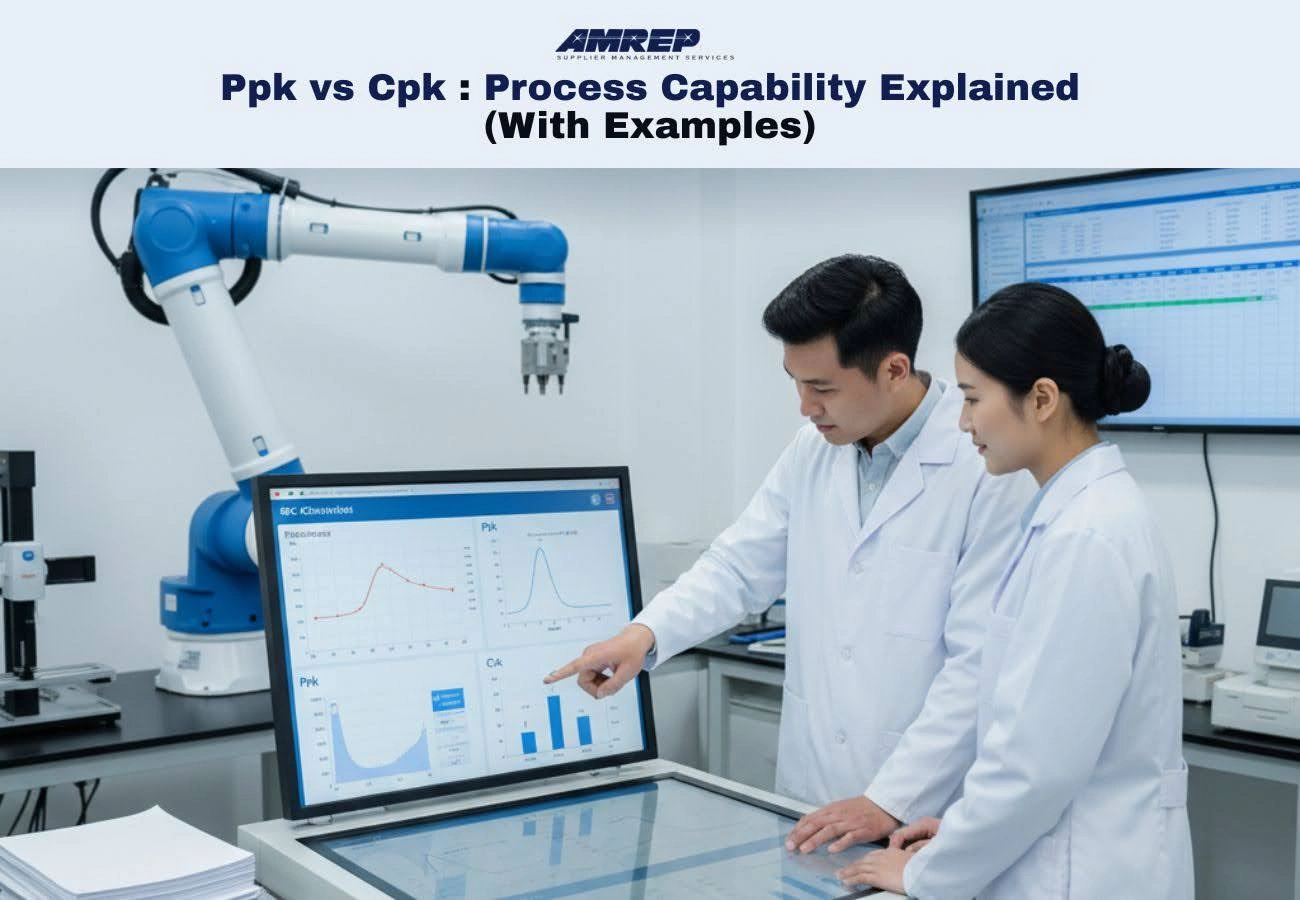
Process capability refers to the ability of a manufacturing or operational process to produce output that meets customer specifications or tolerance limits. In simple terms, it tells us how well a process performs relative to its required standards.
A capable process is one that produces outputs consistently within the specification limits. The smaller the variation (σ), the more capable the process.
These are the three primary indices used to evaluate process capability:
| Index | Description | Measures | Uses |
|---|---|---|---|
| Cp | Potential process capability | Process spread vs. specification width | Ideal capability assuming process is centered |
| Cpk | Process capability index | Process variation and centering | Realistic capability of an in-control process |
| Ppk | Process performance index | Overall process variation and centering | Realistic capability including all variation (short & long term) |
Let’s explore the two most compared ones: Cpk and Ppk.
Cpk stands for Process Capability Index. It measures how close a process is running to its specification limits, considering only the within-subgroup variation (short-term variation).
This means Cpk evaluates the capability of a process that is stable and in control.
Cpk = min(USL−μ/3σ, μ−LSL/ 3σ)
Where:
The “3σ” term represents three standard deviations from the mean, corresponding to approximately 99.73% of data in a normal distribution.
| Cpk Value | Interpretation |
|---|---|
| < 1.0 | Process not capable (many defects) |
| = 1.0 | Process barely meets specs (~2700 ppm defective) |
| 1.33 | Minimum acceptable capability for many industries |
| 1.67 | Good capability (tight control) |
| ≥ 2.0 | Excellent capability (Six Sigma level) |
Example:
Suppose the diameter of a shaft has a USL = 20.05 mm and LSL = 19.95 mm. The process means (μ) = 20.00 mm, and σ = 0.01 mm.
Cpk = min (20.05−20.00 /3(0.01), 20.00−19.95 / 3(0.01)) = min(1.67,1.67) = 1.67
Interpretation: The process is capable and well-centered.
Ppk stands for Process Performance Index. It measures how well a process is performing including both short-term and long-term variations (overall variation).
Unlike Cpk, Ppk uses the overall standard deviation (s) calculated from all data, not just within subgroups. This captures both common cause and special cause variations.
Ppk = min (USL − Xˉ / 3s, Xˉ− LSL / 3s)
Where:
| Ppk Value | Interpretation |
|---|---|
| < 1.0 | Process not capable |
| = 1.0 | Barely meets specs |
| 1.33 | Minimum acceptable in most cases |
| ≥ 1.67 | Highly capable |
| ≥ 2.0 | World-class performance |
Example:
Using the same data as before but suppose the overall standard deviation over time (s) = 0.015 mm.
Ppk = min (20.05−20.00 / 3(0.015), 20.00−19.95 / 3(0.015)) = min (1.11,1.11) = 1.11
Interpretation: The process appears capable short term (Cpk = 1.67), but long term performance (Ppk = 1.11) shows more variation, indicating possible process drift or instability.
While both indices measure how well a process meets specifications, they differ primarily in which variation they consider.
| Aspect | Cpk | Ppk |
|---|---|---|
| Type of variation | Within-subgroup (short-term) | Overall (short + long-term) |
| Stability required | Assumes stable, in-control process | Can be used even if process is not fully stable |
| Use case | Process capability (potential) | Process performance (actual) |
| Data source | Subgroup data | All data combined |
| Calculation of σ | Within-subgroup σ | Overall standard deviation s |
| Result magnitude | Usually higher | Usually lower |
| Indicates | What process can do | What process actually does |
In essence:
Example:
In a Six Sigma project, after eliminating special causes, you might calculate Cpk to verify the optimized process capability.
Example:
Before launching a new production line, engineers calculate Ppk to measure current performance, including setup and environmental variations.
Generally:
Ppk ≤ Cpk
This is because overall variation (used in Ppk) is typically greater than within-subgroup variation (used in Cpk).
If Ppk ≈ Cpk, it indicates a stable process with consistent performance.
If Ppk < Cpk, it suggests instability, special causes, or process drift over time.
| Metric | Value | Interpretation |
|---|---|---|
| Cpk | 1.67 | Capable short-term |
| Ppk | 1.11 | Less capable long-term |
| Difference | 0.56 | Process instability present |
Let’s illustrate the full calculation.
Scenario:
A company produces metal rods with the following specs:
| Sample | Measurement (mm) |
|---|---|
| 1 | 49.9 |
| 2 | 50.0 |
| 3 | 49.8 |
| 4 | 50.1 |
| 5 | 50.2 |
| ... | ... |
| 25 | 50.0 |
Step 1: Compute Mean (μ)
Assume mean = 50.0 mm.
Step 2: Compute Within-Subgroup σ (short-term)
From control chart subgroup data: σ = 0.05 mm.
Step 3: Compute Overall Standard Deviation (s)
From all data combined: s = 0.07 mm.
Step 4: Calculate Cpk
Cpk = min (50.2−50.0 / 3(0.05), 50.0−49.8 / 3(0.05)) = min (1.33,1.33) = 1.33
Step 5: Calculate Ppk
Ppk = min (50.2 − 50.0 / 3(0.07), 50.0−49.8 / 3(0.07)) = min (0.95,0.95) = 0.95
Interpretation:
The process looks capable short-term but underperforms long-term due to extra variation. Improvement actions should focus on identifying and removing long-term variation sources (e.g., equipment wear, operator methods, environmental factors).
When there’s a large difference between Cpk and Ppk, it indicates process instability. Possible causes include:
Both Ppk and Cpk assume a normal (bell-shaped) distribution of process data. If the data are not normal, the indices may not reflect the true capability.
If data are non-normal:
Different industries set minimum capability requirements:
| Industry | Minimum Cpk/Ppk | Notes |
|---|---|---|
| Automotive (IATF 16949) | ≥ 1.67 preferred | 1.33 minimum for short-term |
| Aerospace | ≥ 1.33 | Higher for critical features |
| Electronics | ≥ 1.67 | Tight tolerance components |
| Pharmaceutical | ≥ 1.33 | Quality-critical processes |
| Six Sigma Programs | ≥ 2.0 | World-class capability |
These benchmarks help determine whether a process requires improvement or can be accepted as is.
A graphical view makes understanding Cpk and Ppk easier.
Imagine two bell curves:
In Six Sigma methodology, process capability indices are used to measure performance levels:
| Sigma Level | Cpk (Approx.) | Defects per Million (DPMO) |
|---|---|---|
| 3σ | 1.0 | 2700 |
| 4σ | 1.33 | 63 |
| 5σ | 1.67 | 0.57 |
| 6σ | 2.0 | 0.002 |
Thus, Cpk = 2.0 corresponds to Six Sigma capability, with only 3.4 defects per million opportunities (DPMO) after considering a 1.5σ shift.
If your process demonstrates low Cpk or Ppk values, it indicates that performance is inconsistent or not meeting specifications. To enhance process capability and achieve more stable, high-quality output, consider taking the following steps:
If you’re evaluating new suppliers or expanding production, our article [10 Things to Check Before Signing with a New Manufacturer] offers practical insights to help you choose reliable manufacturing partners.
| Feature | Cpk | Ppk |
|---|---|---|
| Type | Process Capability Index | Process Performance Index |
| Focus | Short-term, potential capability | Long-term, actual performance |
| Data | Subgroup variation | Overall variation |
| Stability Assumed | Stable process | May be unstable |
| Application | Process in control | Initial or unstable processes |
| Common Outcome | Higher value | Lower value |
Both Ppk and Cpk are indispensable tools in assessing and improving process quality. Understanding their differences empowers quality engineers and managers to make data-driven decisions:
Strong supplier relationships begin with a structured onboarding process. Check out our [Supplier Onboarding Checklist] to make sure every critical step is covered before production begins.
At AMREP, a leading supplier quality management company, we believe that data-driven insights are the foundation of sustainable quality improvement. Our inspection and process evaluation services help manufacturers uncover variation, enhance stability, and maintain precision and reliability across every product you make.
Measure precisely. Improve continuously. Deliver quality every time.
Contact Us To See What We Can Do
Call Us
Mon - Sat 9.00 - 18.00
Sunday Closed


12 - May 2025
12
May
2025
Malaysia is a premier manufacturing hub in Southeast Asia. According to the Malaysian Investment Development Authority (MIDA), “Malaysia, with its extensive trade....

22 - April 2025
22
April
2025
Healthcare is rapidly evolving, ensuring consistent and high-quality patient care. Total Quality Management (TQM) in healthcare is more than just a buzzword—it is a powerful....

16 - April 2025
16
April
2025
Total Quality Management (TQM) is a mindset that involves everyone in the organization working toward a common goal: achieving excellence through quality. From....


Our website uses cookies to improve your experience. Read our Cookie Policy for more information.