Mon - Sat 9.00 - 18.00

Sunday Closed

Call Us

+1 858 329 0211

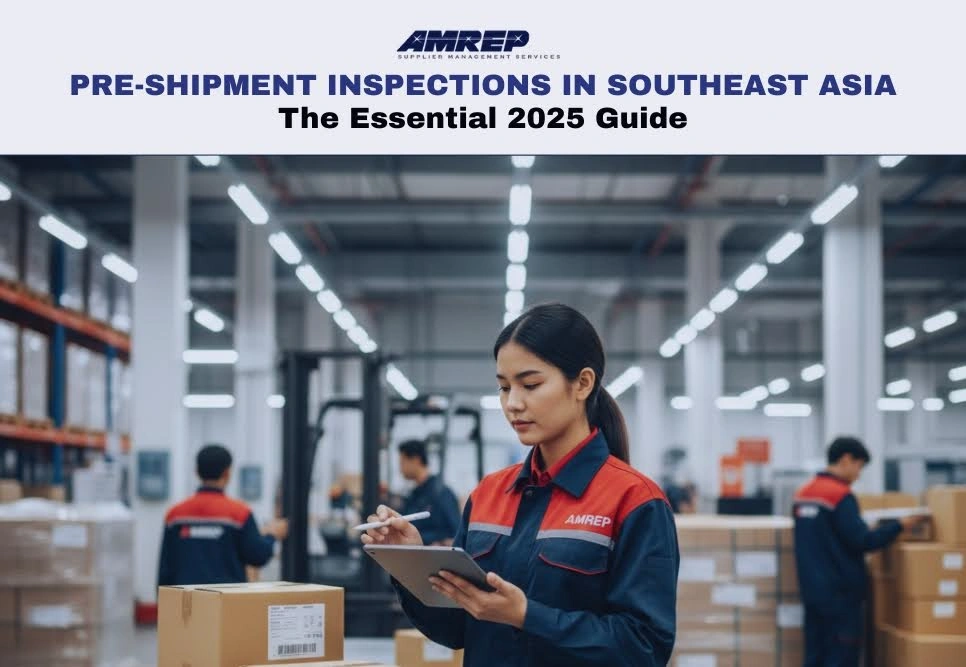
Pre-Shipment Inspections in Southeast Asia: The Essential 2025 Guide

By AMREP | Posted on November 21, 2025

Southeast Asia has become the factory floor and distribution hub for much of the world. Production lines feed millions of containers that flow through the region’s ports annually.

This Image Depicts Check Before Signing With a New Manufacturer

For importers, brands, and e-commerce sellers, there is a simple but critical question:

How do you make sure what’s loaded into those containers is exactly what you paid for – before it sails?

This is precisely where pre-shipment inspections (PSI) make all the difference.

This guide walks you through what PSI is, how it works specifically in Southeast Asia, the regulatory backdrop, and how to use inspections strategically rather than just as a box-ticking exercise.

What Is a Pre-Shipment Inspection?

A pre-shipment inspection (PSI) is an on-site quality and conformity check performed after production is finished (typically when 80–100% of goods are made and packed) but before the goods leave the factory or warehouse. Typically conducted by a third-party inspection company or sometimes a government-authorized body, PSI verifies:

  • Product quality and workmanship
  • Quantity and assortment
  • Specifications versus contract or approved samples
  • Functionality and basic performance
  • Labeling, markings, and barcodes
  • Packaging and shipping marks

Under WTO rules, governments may also require PSI as a non-tariff measure (NTM) to verify quality, quantity, or price as part of customs or trade policy.

Why Pre-Shipment Inspection Matters So Much in Southeast Asia

A fast-growing export & manufacturing hub

Southeast Asia’s 11 countries host major ports like Singapore, Port Klang and Tanjung Pelepas (Malaysia), Laem Chabang (Thailand), Ho Chi Minh and Hai Phong (Vietnam), Tanjung Priok (Indonesia), and Manila (Philippines).

At the same time, global trade realignment and rising costs in China have pushed more production to countries such as Vietnam, Thailand, Indonesia, and Cambodia, especially in textiles, footwear, electronics, and furniture.

That shift creates massive opportunity, but also risk:

  • New or untested factories
  • Rapidly scaling suppliers outgrowing their systems
  • Complex multi-country supply chains with components coming from different origins

PSI acts as a safety valve to catch issues before they turn into expensive disasters.

Regulatory landscape: PSI as a non-tariff measure

Within ASEAN, pre-shipment inspections sit under the umbrella of non-tariff measures (NTMs) – specifically categorized alongside other “pre-shipment inspection and formalities” measures in the ASEAN Trade Repository.

Some governments historically required PSI for imported goods to:

  • Combat under-invoicing and fraud
  • Prevent substandard or unsafe goods
  • Verify quantity and price before customs clearance

Although many mandatory PSI schemes have been relaxed or reformed over time, the concept remains deeply embedded in trade compliance across Asia.

A booming and evolving PSI market

The global pre-shipment inspection market is forecast to reach around USD 21.8 billion by 2032, with strong growth driven by globalized supply chains and stricter quality expectations.

In the Asia–Pacific region, the PSI market is undergoing a digital shift, with more remote inspection tools, AI-driven quality control, and digital reporting platforms supplementing traditional on-site checks.

For Southeast Asia, this means:

  • Easier access to inspection services even in second-tier industrial zones
  • Faster reporting and decision-making
  • New models like video-based inspections for lower-risk or repeat items

What Actually Happens During a Pre-Shipment Inspection?

While each company has its own methodology, most reputable PSI providers in Asia follow very similar steps, often based on standards like ISO 2859-1 / ANSI AQL for sampling.

Typical step-by-step process

  1. Booking & preparation
    • Buyer submits a booking, purchase order, product specs, and key quality points.
    • Inspection date is set when 80–100% of goods are finished and packed.
  2. On-site kick-off
    • Inspector arrives at the factory / warehouse in, say, Ho Chi Minh City, Bangkok, or Jakarta.
    • Confirms that goods are ready and segregated for inspection.
  3. Sampling
    • Random sampling is done based on AQL sampling plans (ISO 2859-1), ensuring a statistically valid sample rather than cherry-picked pieces.
  4. Physical inspection & testing
    • Visual checks for appearance, workmanship, finish
    • Dimensions & weight measurement
    • Function tests (for electronics, machinery, toys, etc.)
    • On-site tests where relevant: carton drop tests, colorfastness, basic electrical safety, smell test for chemicals or textiles, etc.
  5. Quantity & packing verification
    • Count of units, inner/outer cartons, and pallet configuration
    • Verification of labels, barcodes, logos, and regulatory marks
    • Check of packaging strength and shipping marks
  6. Compliance review
    • Comparison against:
      • Approved samples
      • Buyer’s specification sheet
      • Contract requirements
      • Any relevant standards (e.g., EU, US, AU regulations)
  7. Reporting & verdict
    • Inspector compiles a detailed report with photos, test results, defect counts, and a conclusion:
      • Pass (within AQL)
      • Fail (beyond AQL)
      • Conditional pass (issues noted; buyer to decide)
  8. Decision by buyer
    • Buyer chooses to:
      • Approve shipment
      • Request rework and re-inspection
      • Reject shipment or negotiate compensation

Key Sectors Using PSI in Southeast Asia

While almost any product can be inspected, some categories dominate PSI bookings in Southeast Asia:

  • Textiles & garments – Vietnam, Cambodia, Indonesia
    • Checks: stitching, measurements, colorfastness, fabric GSM, logo placement.
  • Footwear & leather goods – Vietnam, Indonesia, Cambodia
    • Checks: bonding strength, sole flexibility, symmetry, finishing.
  • Furniture & homeware – Vietnam, Indonesia, Malaysia
    • Checks: stability, load tests, surface finish, assembly, packaging protection.
  • Consumer electronics & components – Malaysia, Thailand, Vietnam, Singapore
    • Checks: functionality, safety, labels, critical dimensions, accessories, manuals.
  • Toys & children’s products – regional supply to US/EU markets
    • Checks: small parts, sharp edges, labeling, basic safety tests (often combined with lab testing).
  • Food & agriculture products – Thailand, Vietnam, Philippines, Indonesia
    • Checks: packaging integrity, labeling, visible contamination; often paired with lab tests and SPS measures.

In all these sectors, PSI serves as the final quality control barrier before the goods meet international buyers and regulatory authorities.

Benefits of Pre-Shipment Inspection for Different Players

For Importers and Brands

  • Avoid paying for defective goods or incorrect quantities
  • Reduce returns, chargebacks, and warranty claims
  • Protect brand reputation in destination markets
  • Documented evidence in case of disputes with suppliers
  • Greater confidence to scale purchasing from new factories

For Southeast Asian Exporters & Manufacturers

While some suppliers see PSI as “policing,” it can actually help them:

  • Identify process weaknesses and recurring defects
  • Reduce rework and last-minute firefighting
  • Demonstrate reliability to new customers
  • Support continuous improvement and certifications like ISO 9001

Many factories eventually adopt in-house quality control modeled after third-party PSI checklists.

For regulators and customs

When used as an NTM, government-mandated PSI can:

  • Help combat substandard imports and fraudulent declarations
  • Support consumer safety and fair market competition
  • Provide pre-arrival data for risk-based customs clearance

What Makes Southeast Asian Sourcing Challenging and How to Address It

Of course, PSI is not magic. In Southeast Asia’s diverse and fast-moving environment, several challenges pop up regularly.

“Too Late” Inspections

If PSI is booked too close to vessel cutoff, there may be:

  • No time to rework defects
  • Strong pressure to “ship anyway” and “fix next order”

Best practice is to schedule PSI at least 1–2 working days before loading, giving room for decisions.

Misaligned expectations

If buyers do not clearly specify:

  • AQL levels
  • Must-have vs nice-to-have requirements
  • Critical defects that trigger automatic fail

Inspectors have to rely on generic checklists, which may not reflect what truly matters to the buyer.

Fragmented Production

In Southeast Asia, it’s common for:

  • Components made in one factory
  • Final assembly in another
  • Packing in a separate warehouse

If PSI is done only at one location without proper traceability, hidden defects from upstream suppliers might be missed.

Over-Reliance on PSI Alone

PSI is a final gate, not a full quality system. If there’s:

  • No incoming material inspection
  • Weak in-process controls
  • Poor supplier qualification

PSI may simply keep catching the same issues repeatedly, which is costly for everyone.

Misalignment between buyers and factories is one of the most common root causes of quality issues. To build stronger clarity from the start, you may find value in our article: How to Set Expectations with New Overseas Suppliers: A Complete Guide.

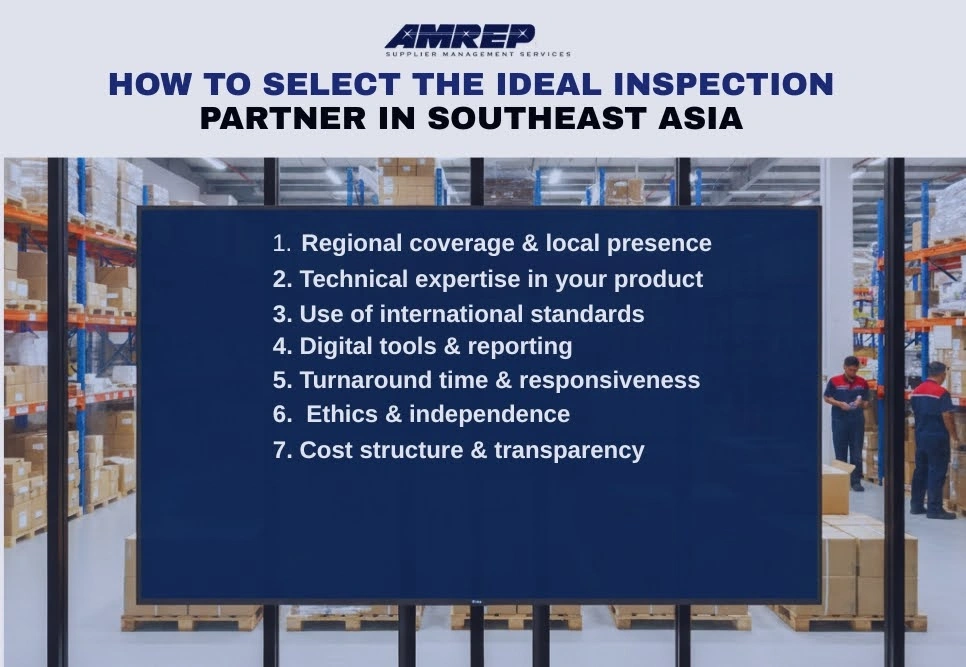
How to Select the Ideal Inspection Partner in Southeast Asia

With dozens of inspection firms active across the region, how do you choose?

This Image Depicts With dozens of inspection firms active across the region, how do you choose?

Here are practical criteria:

Regional Coverage & Local Presence

  • Do they have inspectors in your key hubs (e.g., Vietnam’s main industrial zones, Jakarta area, greater Bangkok, Penang, Cebu/Manila)?
  • Can they reach secondary cities without excessive travel surcharges?

Technical expertise in your product

  • Do they show sector-specific checklists (e.g., furniture load testing, toy safety, electronics function tests)?

Use of International Standards

  • Sampling per ISO 2859-1 / ANSI AQL
  • Relevant test standards (ASTM, IEC, EN, etc.) for on-site tests

Digital Tools & Reporting

  • Mobile data capture, photo and video evidence
  • Online dashboards and historical data trends
  • Ability to support remote / video inspections where appropriate

Turnaround Time & Responsiveness

  • Can they deploy inspectors within 24–48 hours in key Southeast Asian markets?

Ethics & Independence

  • Clear policies against gifts or incentives from factories
  • Strong internal quality reviews of reports
  • Accredited where relevant

Cost Structure & Transparency

  • Flat day rates vs % of FOB value
  • Clear add-ons (travel, lab tests, overtime) so you can budget accurately

A strong sourcing process begins with thorough supplier qualification. For a step-by-step framework that complements your PSI workflow, explore our Supplier Onboarding Checklist: Steps for a Seamless Vendor Transition.

The PSI world is changing rapidly, and Southeast Asia is one of the main test beds for innovation.

Remote and Hybrid Inspections

Driven by travel disruptions and technology advances, more PSI providers now offer:

  • Live video inspections (inspector or factory staff streaming to remote QA experts)
  • Photo-only or checklist-guided self-inspections for low-risk SKUs
  • Hybrid models where critical tests are on-site, while simple checks are remote

These models can cut costs and speed up decisions for repeat orders or low-value items, while full on-site PSI remains standard for complex or high-risk products.

Data-Driven Supplier Management

With digital platforms aggregating thousands of inspections across factories, buyers can:

  • Track defect trends by supplier or region
  • Identify chronic issues and target improvement programs
  • Use performance scores when allocating new orders

This is especially valuable when you’re sourcing from multiple Southeast Asian countries and juggling numerous vendors.

ESG and Sustainability Checks

Beyond basic quality, more brands use PSI visits to:

  • Spot labor and safety red flags
  • Verify packaging sustainability claims
  • Check for hazardous materials or non-compliant substances (often via lab testing add-ons)

While PSI is not a full social audit, inspectors are increasingly trained to flag ESG concerns for further investigation.

Your Actionable Checklist for Successful PSI in Southeast Asia

Here’s a concise, action-oriented checklist you can plug into your sourcing process.

  • Before production
    • Select factories with basic quality systems (incoming checks, process controls).
    • Share detailed specifications: drawings, tolerances, packaging instructions, photos.
    • Define AQL levels and defect categories:
      • Critical (e.g., safety issues, wrong product)
      • Major (functional or obvious defects)
      • Minor (small cosmetic flaws)
  • During production
    • For large/complex orders, consider a During Production Inspection (DUPRO) at 20–60% completion to catch problems early; then PSI is the final check.
  • Before shipment (pre-shipment inspection)
    • Book PSI when 80–100% of goods are completed and at least 80% packed.
    • Ensure factory understands:
      • Goods must be fully accessible (not buried in containers)
      • Someone responsible is on site to answer questions and open cartons
    • Provide inspection company with:
      • PO, packing list, specs, artwork
      • Approved pre-production samples
      • Any special tests or regulatory checks required (e.g., toy safety, electrical safety)
  • After inspection
    • Review the report promptly and avoid skimming only the verdict page.
    • Pay attention to:
      • Systematic defects vs random errors
      • Any deviations from agreed packing or labeling
    • Decide:
      • Accept, accept with concession, or require rework & re-inspection.
    • Log results in a supplier scorecard to guide future sourcing decisions.

Treat PSI as Strategy, Not Just Insurance

Pre-shipment inspection in Southeast Asia is sometimes seen as a necessary formality, just another cost, another step, and another layer of friction.

But used intelligently, PSI becomes a strategic tool:

  • It reduces risk in a region where suppliers may be new, fast-growing, or geographically dispersed.
  • It supports long-term partnerships, showing suppliers exactly where they need to improve.
  • It feeds data back into your supplier management, product development, and risk management systems.
  • And in a world of tight margins and unforgiving customers, catching a defect before a container leaves Singapore, Port Klang, Laem Chabang or Tanjung Priok is almost always cheaper than dealing with it after arrival.

Sourcing from Southeast Asia demands a structured approach to quality, and integrating PSI into your standard workflow is one of the most effective steps you can take. In the long run, the investment in inspections is minimal compared to the substantial costs and risks associated with quality failures.

AMREP: Your Partner in Quality, Reliability, and Global Competitiveness

The most successful companies treat quality not as an afterthought but as a strategic advantage. AMREP, a trusted supplier quality management company, brings decades of inspection expertise to help businesses navigate the complexities of Southeast Asian manufacturing and build resilient, high-performing supply chains. With AMREP at your side, you can move forward with certainty and compete with confidence in global markets.

Don't Forget to Share This Post

Contact Us To See What We Can Do

Call Us

+1 858 329 0211

Mon - Sat 9.00 - 18.00

Sunday Closed

Get In Touch

12 - May 2025

12

May

2025

Guide to Qualifying New Suppliers in Malaysia for Manufacturing Success

Malaysia is a premier manufacturing hub in Southeast Asia. According to the Malaysian Investment Development Authority (MIDA), “Malaysia, with its extensive trade....

22 - April 2025

22

April

2025

Total Quality Management in Healthcare: Elevating Patient Care and Operational Efficiency

Healthcare is rapidly evolving, ensuring consistent and high-quality patient care. Total Quality Management (TQM) in healthcare is more than just a buzzword—it is a powerful....
16 - April 2025

16

April

2025

Principles of Total Quality Management (TQM)

Total Quality Management (TQM) is a mindset that involves everyone in the organization working toward a common goal: achieving excellence through quality. From....


Footer Banner Image