Guide to Qualifying New Suppliers in Malaysia for Manufacturing Success
Malaysia is a premier manufacturing hub in Southeast Asia. According to the Malaysian Investment Development Authority (MIDA), “Malaysia, with its extensive trade....

By AMREP | Posted on July 28, 2026
Container loading supervision (CLS) is a third-party inspection performed while your goods are loaded into a shipping container at the factory or warehouse. A trained inspector is present throughout the loading process.
The inspector verifies the quantity, product identity, and packaging of the goods being loaded. They also check the condition of the shipping container and document the entire loading process with photographs. Once loading is complete, a high-security seal is applied to the container. It is the final independent checkpoint between a passed quality inspection and a sealed container on its way to the port.
That gap, between the goods you approved and the goods that were actually loaded, is where two expensive problems live: short shipments and product swaps. This guide explains both, how loading supervision catches them, exactly what a supervisor does at the container, and how to decide when you need it.
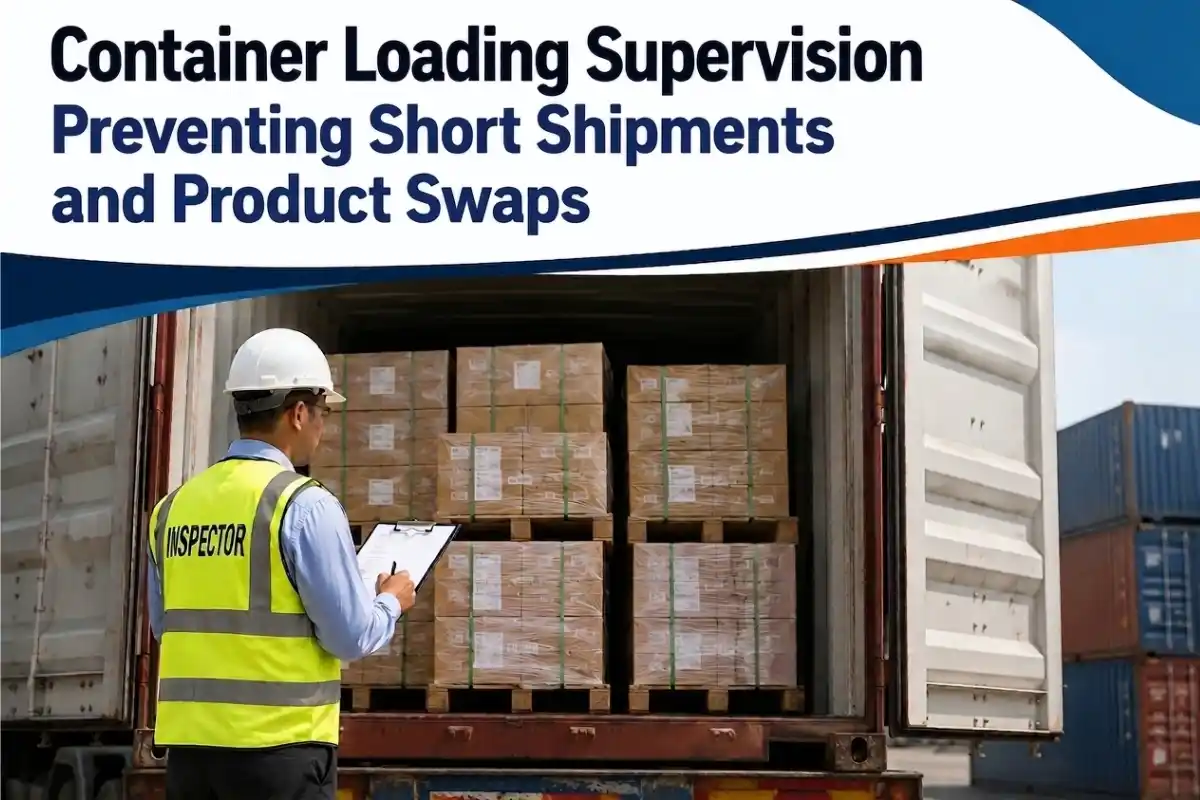
A pre-shipment inspection confirms that a sample of finished goods meets your specifications. Container loading supervision confirms that the actual cartons loaded into the container match the approved product. It also verifies that the correct quantity is loaded, the packaging is in good condition, the goods are stowed properly, and the container is sealed under observation.
The distinction matters because a product can pass its final inspection and still arrive incorrectly. Cartons can be miscounted. Pallets can be left on the dock. A supplier under margin pressure may substitute a cheaper component or an older production lot after the inspector leaves. Fragile goods may be loaded improperly and arrive damaged. None of these issues are caught by inspecting a sample a few days earlier. They are identified only by supervising the container loading process.
CLS typically covers three phases. First, the empty container is inspected before loading. Next, the inspector supervises and counts the goods during loading. Finally, the inspector verifies the container seal and shipping documents after loading. The result is a time-stamped, photo-documented report that you receive before the truck leaves the yard, giving you the opportunity to resolve any discrepancies before shipment.
A short shipment is simple to define and costly to experience. You paid for goods you never received. It happens more often than many buyers realize and is rarely the result of fraud. Common causes include a miscount during hand loading, a pallet or carton left behind, a labeling error that sends part of the order to the wrong container, or a supplier shipping only what was completed and promising to deliver the rest later.
The financial impact adds up quickly. You've already paid or committed to the full order value, but you are left short on inventory needed to meet customer demand. By the time the shortage is discovered at your warehouse, the container has cleared customs, the supplier is weeks removed from the shipment, and proving what was actually loaded versus what was lost or stolen in transit is extremely difficult.
Loading supervision prevents this problem at the source. The inspector independently counts every carton as it is loaded and compares the total with the packing list and purchase order. Any discrepancy is identified before the container is sealed, giving the supplier an opportunity to correct it before it becomes a costly dispute.
Product swaps are more difficult to detect because they are intentional. A supplier ships a different product, often a lower-quality or non-conforming version, instead of the product you inspected and approved. Common variants include:
These product swaps are not detected during a sample-based final inspection because they happen after the inspection is completed. The solution is to supervise the loading process. The inspector opens cartons at random throughout the shipment, not just those on top, and verifies the product identity, model, markings, and lot codes against the approved reference. This confirms that the goods being loaded are the same ones you approved. Photographs of the opened cartons inside the container provide clear evidence of what was actually shipped.
If you already run a pre-shipment inspection, you might reasonably ask why you'd also supervise loading. The answer is that a PSI and CLS verify two different things at two different moments.
A pre-shipment inspection is usually performed when production is at least 80% complete and the goods are packed. It uses a statistical sample, often based on an AQL plan, to assess the quality of a representative portion of the shipment. This is the right method for verifying workmanship, product functionality, and compliance with specifications.
However, it only inspects a sample at a single point in time. Once the inspection is finished, the inspector leaves. The loading process, carton count, stowage, and any product substitutions that occur before the container is sealed are not verified.
Container loading supervision fills this gap. It does not replace a pre-shipment inspection. Instead, it confirms that the goods approved during the inspection are the same goods loaded into the container, in the correct quantity, in good condition, and sealed before shipment.
For high-value, high-volume, or high-risk shipments, using both services provides the strongest protection. A pre-shipment inspection verifies product quality, while container loading supervision verifies shipment accuracy and integrity. Together, they help ensure the right products leave the factory. You can arrange both through AMREP's quality inspection services as a single coordinated program.
A professional loading supervision follows a disciplined sequence. Here is what a competent inspector actually does.
Inspect the empty container. Before a single carton goes in, the supervisor examines the container itself for structural integrity, cleanliness, dryness, odor, pest evidence, and signs of prior damage or repair. A container with holes, water stains, a damaged roof, or a lingering chemical smell will damage or contaminate your goods regardless of how well they're packed. This step follows the internationally recognized seven-point container inspection used under C-TPAT (see below), which also screens for the hidden compartments and false walls that signal a security-compromised box.
Check carton condition and markings. The supervisor confirms that export cartons are intact, correctly marked with shipping marks and labels, and consistent with the packing list. This helps ensure that no water-damaged, crushed, or mislabeled cartons are loaded into the container.
Review the documents. The purchase order, packing list, and any required shipping marks are cross-checked so the count and product identity have a baseline to reconcile against.
Independent tally count. Every carton, or every pallet with the cartons per pallet verified, is counted as it is loaded into the container and reconciled against the packing list. This is the core defense against short shipments.
Random product verification. Cartons are opened at random from different areas and layers of the load, and the contents are checked against the approved sample. The inspector verifies the correct product, model, quantity per carton, markings, and lot or date codes. This is the core defense against swaps.
Loading technique and stowage. The supervisor monitors how the container is loaded: even weight distribution, secure stacking, no crushing of lower cartons, appropriate use of dunnage, bracing, and void-fill, and separation of incompatible goods. Good stowage prevents the transit damage that is otherwise blamed on "shipping."
Real-time reporting. Issues are raised on the spot with the factory, so a miscount or a damaged pallet can be corrected before the doors close rather than disputed after arrival.
Seal verification. Once loading is complete and the container doors are closed, a high-security seal that meets ISO 17712 Class H requirements is applied. The supervisor records the unique seal number, confirms it matches the shipping documentation, and follows the VVTT seal integrity process, View, Verify, Tug, and Twist, to confirm the seal is genuine and properly secured. Under the SAFE Port Act, high-security seals are mandatory for loaded containers shipped to the United States.
Photographic report. The supervisor documents the entire loading process. This includes the empty container, container and seal numbers, cartons and shipping markings, open carton contents, the loading process, the fully loaded container, and the sealed container doors with the seal number clearly visible.
The report is delivered before the container leaves the facility. This gives you time to review the findings and resolve any issues while corrective action is still possible.
The seven-point inspection of the empty container is the security backbone of loading supervision. Each area is checked for structural soundness and for evidence of tampering or hidden compartments.
| # | Inspection point | What the supervisor looks for |
|---|---|---|
| 1 | Front wall | Corner blocks visible; no false wall reducing interior length |
| 2 | Left side | Solid, uniform wall; no unusual repairs or plating |
| 3 | Right side | Solid, uniform wall; consistent with the left side |
| 4 | Floor | Flat and uniform; no raised sections hiding a compartment |
| 5 | Ceiling / roof | No pinholes of light, patches, or water damage |
| 6 | Inside/outside doors | Reliable locking mechanism; intact, undamaged seals and hinges |
| 7 | Outside / undercarriage | Support beams visible; no foreign material or hidden compartments |
Loading supervision isn't required on every shipment, but it earns its cost quickly in these situations:
If several of these describe your shipment, the container door is exactly where an independent set of eyes pays for itself.
| Pre-Shipment Inspection (PSI) | Container Loading Supervision (CLS) | |
|---|---|---|
| Question answered | Is the product made to specification? | Are the approved goods actually loaded, in full, undamaged, and sealed? |
| When | Production ~80%+ complete and packed | At the moment of container loading |
| Method | Statistical sample (AQL) of finished goods | Full tally count + random open-carton verification of the actual load |
| Primary risks caught | Defects, workmanship, function, spec conformity | Short shipments, product swaps, transit-damage-in-loading, seal integrity |
| Output | Inspection report on lot quality | Photo-documented loading report + verified seal record |
They are complementary, not alternatives. PSI verifies quality; CLS verifies that the verified quality is what ships.
Not all loading supervision is equal. When selecting a partner, look for:
Usually one inspector man-day per container, with the rate depending on the country. It's a small cost next to the value of a single short shipment or a container of substituted product, which is why buyers focus it on high-value, high-risk, or problem-supplier loads rather than every order.
A few hours to a full day, depending on container count and how the goods are loaded. Palletized loads go quickly; loose, hand-counted cargo takes longest, and that's exactly where miscounts happen.
You're told in real time, and the decision is yours. The inspector documents and advises but won't cancel your order. Because it's flagged before the doors seal, you can still have missing pallets loaded, wrong cartons swapped out, or the container held. That window is the whole point of checking at the door instead of at your warehouse.
Rarely the same day: a PSI happens at about 80% production, while loading comes later once everything is packed. But the same provider can run both as one program, which lowers cost and means the loading inspector already knows the approved product.
Yes, but the setup differs. Since LCL goods are combined with other shippers' cargo at a consolidation warehouse, supervision verifies your count and product identity at handover, before your goods go into a shared container you don't control.
It can't prevent something at sea, but it makes a loss provable. A documented, photographed, correctly counted load under a numbered ISO 17712 seal is often the deciding evidence in an insurance or liability claim.
AMREP provides third-party inspection services, including container loading supervision, source inspections, and pre-shipment verification, across Mexico, Vietnam, Malaysia, Thailand, China, and the Philippines. Our inspectors count what actually loads, verify it against your approved product, and hand you a photo-documented report before the container leaves the yard, so short shipments and swaps are caught at the door, not at your dock. Contact AMREP to set up loading supervision for your next shipment.
Contact Us To See What We Can Do
Call Us
Mon - Sat 9.00 - 18.00
Sunday Closed

12 - May 2025
12
May
2025
Malaysia is a premier manufacturing hub in Southeast Asia. According to the Malaysian Investment Development Authority (MIDA), “Malaysia, with its extensive trade....

22 - April 2025
22
April
2025
Healthcare is rapidly evolving, ensuring consistent and high-quality patient care. Total Quality Management (TQM) in healthcare is more than just a buzzword—it is a powerful....
16 - April 2025
16
April
2025
Total Quality Management (TQM) is a mindset that involves everyone in the organization working toward a common goal: achieving excellence through quality. From....


Our website uses cookies to improve your experience. Read our Cookie Policy for more information.