Mon - Sat 9.00 - 18.00

Sunday Closed

Call Us

+1 858 329 0211

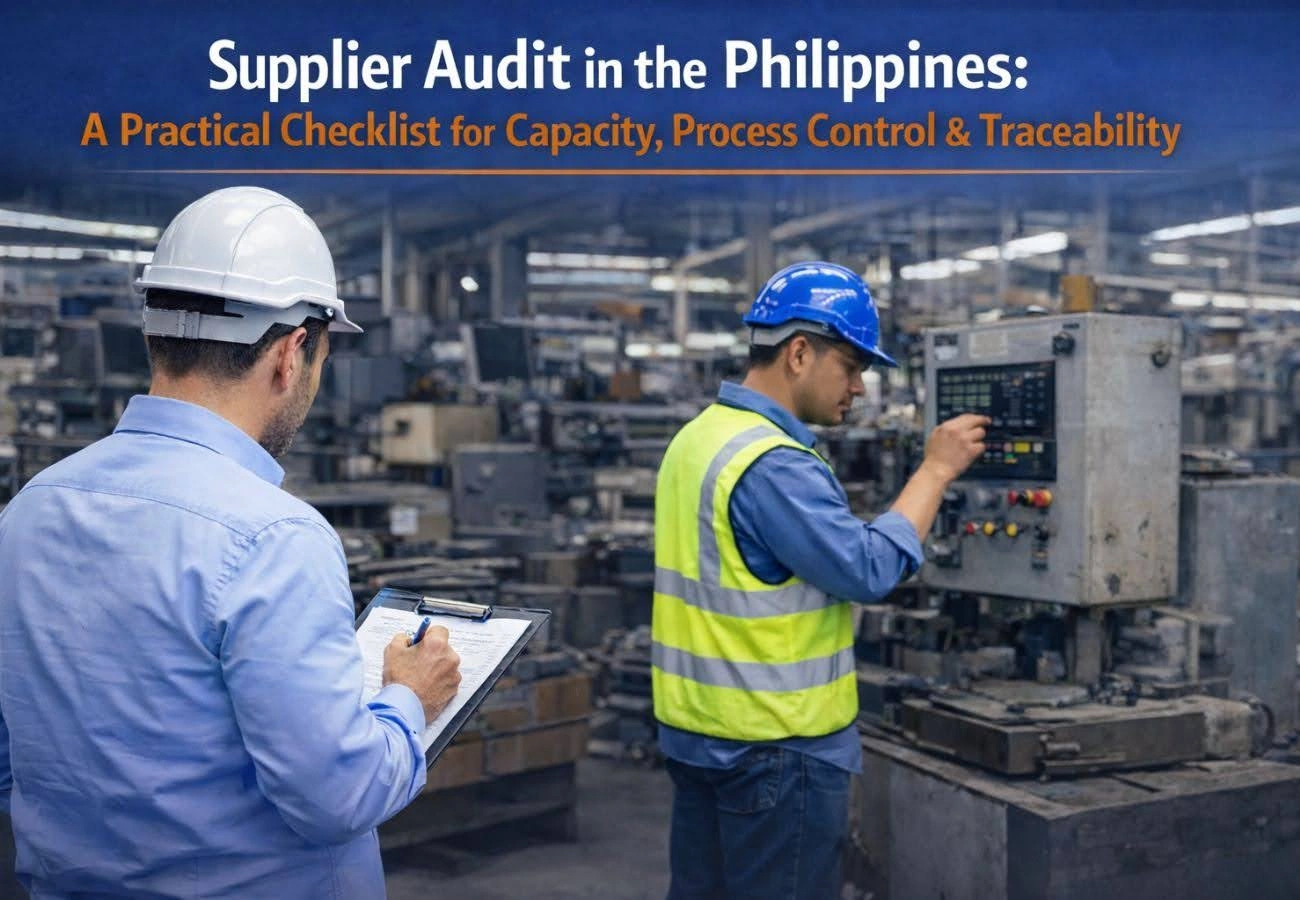
Supplier Audit in the Philippines: A Practical Checklist for Capacity, Process Control & Traceability

By AMREP | Posted on January 21, 2026

Supplier audits are no longer optional. They are essential. A well-executed audit can make the difference between consistency and costly disruption.

The Philippines has become a strategic hub for international buyers, offering cost-efficient production and skilled labor. Yet with opportunity comes responsibility: suppliers must prove their capacity, process control, and traceability to meet global standards.

This guide offers a practical checklist to help auditors, quality managers, and procurement professionals confidently assess supplier performance, ensuring every partnership in the Philippine manufacturing sector is built on reliability, transparency, and long-term value.

This Image Depicts Supplier Audit in the Philippines

What Makes the Philippine Supply Chain Unique?

Before diving into the audit itself, it’s vital to understand the industrial backdrop. The Philippines has several distinct manufacturing zones and supplier clusters:

  • Calabarzon (Cavite, Laguna, Batangas, Rizal, Quezon) – Electronics, semiconductors, and automotive.
  • Central Luzon – Metal fabrication, plastics, and packaging.
  • Cebu and Davao – Furniture, textiles, food processing, and BPO support manufacturing.
  • Mindanao – Agriculture-based manufacturing and food exports.

Most suppliers are SMEs (small to medium enterprises), which means that documentation, technology use, and process maturity may vary significantly. Many rely on manual systems and family-owned operations, making capacity validation and process traceability even more important.

The Purpose and Benefits of a Supplier Audit

A supplier audit aims to verify compliance, assess risks, and identify improvement opportunities across the supply chain. In the Philippines, it is especially useful for:

  • Ensuring capacity alignment: Can the supplier meet volume and lead-time commitments?
  • Evaluating process control: Are processes standardized, repeatable, and continuously improved?
  • Assessing traceability: Can the supplier trace every input and batch to its origin?
  • Building trust: Audits promote transparency and foster long-term partnerships.
  • Supporting sustainability and compliance: Many Philippine suppliers must comply with ISO 9001, ISO 14001, or FDA/DOH regulations.

How Should You Prepare Before a Supplier Audit?

A successful audit begins long before the actual inspection. Careful preparation helps you identify risks early, clarify expectations, and create a smoother audit experience for both you and your supplier.

1. Define Audit Objectives and Scope

Determine what you aim to achieve:

  • New supplier qualification
  • Annual performance review
  • Problem-solving or root cause verification
  • Compliance to customer-specific requirements

2. Collect Background Information

Gather:

  • Supplier profile (ownership, location, certifications)
  • Product list and production capacity
  • Quality performance records (PPM rates, defect trends)
  • Prior audit reports (if any)

3. Schedule and Notify

Communicate clearly:

  • Audit agenda
  • Date and duration
  • Auditors’ names
  • Documents to prepare (licenses, process flowcharts, quality manuals)

Good practice: Provide at least 2 weeks notice and request a pre-audit self-assessment.

Supplier Capacity Audit Checklist

A capacity audit ensures that the supplier can meet production volumes consistently without compromising quality.

1. Production Facilities

  • Is the layout optimized for material flow?
  • Are there signs of congestion or underutilization?
  • Are production lines dedicated, shared, or flexible?
  • Are utilities (electricity, water, air) stable and redundant?

Tip: In the Philippines, some suppliers face power interruptions. Check whether they have backup generators or production contingency plans in place.

2. Equipment and Maintenance

  • List of critical equipment and age.
  • Preventive maintenance schedule and records.
  • Availability of spare parts.
  • Calibration of measuring equipment (check traceability to national standards).

Audit red flag: Calibration stickers missing or expired.

3. Workforce Capability

  • Total number of operators, shifts, and work hours.
  • Operator skill matrix and training records.
  • Overtime levels and workforce turnover rates.
  • Health and safety compliance (PPE use, emergency exits).

Local insight: Philippine labor law limits overtime and mandates regularization. Ensure compliance with DOLE (Department of Labor and Employment) rules.

4. Production Planning and Capacity Utilization

  • How does the supplier plan production? (manual, ERP, or spreadsheet)
  • Average capacity utilization (%).
  • Lead time performance trends.
  • Bottleneck analysis and load balancing.

5. Subcontracting and Outsourcing

  • Are any processes subcontracted?
  • If yes, are subcontractors audited or approved?
  • Are capacity changes communicated promptly to customers?

Process Control Audit Checklist

This stage evaluates how well the supplier manages production processes to ensure consistent quality.

1. Process Mapping and Documentation

  • Availability of process flowcharts, control plans, and SOPs.
  • Are instructions displayed on the shop floor?
  • Are operators aware of critical parameters?

2. Raw Material Control

  • Approved supplier list (ASL) and vendor rating.
  • Incoming inspection process and sampling plan.
  • Identification and segregation of accepted/rejected materials.

Note: In many Philippine factories, materials are stored in open or humid environments—check for humidity control, especially for electronics and food.

3. In-Process Controls

  • Key process parameters monitored (temperature, torque, dimensions, etc.).
  • Statistical Process Control (SPC) implementation.
  • Machine settings verification before each run.
  • Line clearance procedures between product changes.

4. Quality Control and Inspection

  • Availability of inspection records.
  • Use of calibrated measuring tools.
  • Defect trend analysis and corrective actions.
  • Final inspection criteria and packaging standards.

Good practice: Philippine suppliers often integrate 5S (Sort, Set, Shine, Standardize, Sustain). Audit its consistency.

5. Nonconformance Management

  • NCR (Non-Conformance Report) system in place?
  • Root cause analysis (e.g., 5 Whys, Fishbone Diagram) used?
  • Effectiveness of corrective and preventive actions (CAPA).

6. Process Improvement

  • Continuous improvement programs (Kaizen, Lean, Six Sigma).
  • Metrics tracked: yield rate, OEE (Overall Equipment Effectiveness).
  • Employee suggestion system for improvement.

Monitoring key process parameters is essential for maintaining consistent quality. To understand how to measure and improve production performance using data, explore our guide on Process Capability Study: What It Is and How to Run It.

Supplier Traceability Audit Checklist

Traceability ensures each product or component can be tracked backward and forward, from raw material to finished goods.

1. Identification and Labeling

  • Are materials and products clearly labeled at every stage?
  • Use of barcodes, RFID, or manual tags?
  • Are labeling systems standardized and tamper-proof?

2. Batch and Lot Control

  • Unique batch numbers assigned at receiving and production stages?
  • Can the supplier trace a batch back to its material source?
  • Can they isolate affected products in case of recall?

3. Record Retention

  • How long are production and inspection records kept?
  • Are records digital or manual?
  • Are backups available (cloud, server, physical)?

Local insight: Some smaller Philippine suppliers rely heavily on paper-based records. Check for legibility and completeness.

4. Supplier and Sub-supplier Traceability

  • Can the supplier trace inputs from sub-suppliers?
  • Are sub-suppliers’ certificates (COC, MSDS, test reports) retained?
  • Are imported raw materials traceable to the country of origin?

5. Product Recall Procedure

  • Is there a documented recall plan?
  • Has the supplier ever executed a recall or mock recall?
  • Average recall time to identify and isolate affected lots.

Environmental and Social Compliance Considerations

While not directly part of process control or traceability, environmental and social compliance can impact brand image and sustainability.

1. Environmental Practices

  • Waste management and segregation.
  • Energy and water conservation efforts.
  • Compliance with DENR (Department of Environment and Natural Resources) regulations.

2. Social Accountability

  • No child or forced labor.
  • Fair wages and safe working conditions.
  • Anti-discrimination and equal employment opportunity.

Audit Scoring and Performance Evaluation

Auditors can assign numerical scores to each category for objective evaluation.

Category Weight (%) Score (1–5) Weighted Score
Capacity 30 4 1.2
Process Control 40 3 1.2
Traceability 20 4 0.8
Compliance & Others 10 3 0.3
Total 100 3.5 / 5

Use color coding:

  • Green (4–5): Acceptable / strong
  • Yellow (2–3): Needs improvement
  • Red (1): Critical noncompliance

Follow up with a Corrective Action Plan (CAP) with clear owners and deadlines.

Common Findings in Philippine Supplier Audits

Auditors frequently encounter similar issues across industries:

Common Issue Root Cause Mitigation
Incomplete process documentation Lack of training Conduct documentation workshops
Expired calibration Cost-saving or oversight Enforce calibration schedules
Manual traceability Lack of digital tools Implement barcode or ERP systems
Overcapacity production Poor forecasting Introduce load planning systems
Weak CAPA effectiveness Superficial root cause Train on structured problem-solving

Post-Audit Review and Follow-Up Actions

Once the audit is completed, the real value comes from how effectively the findings are reviewed, communicated, and acted upon. A structured post-audit process ensures that identified gaps lead to measurable improvements and lasting supplier development.

1. Audit Report

Submit within 5 working days and include:

  • Summary of findings
  • Photos and evidence
  • Ratings and observations
  • Agreed corrective actions

2. Corrective Action Verification

  • Track CAPA closure progress.
  • Conduct re-audit if critical findings remain unresolved.
  • Provide coaching or training where needed.

3. Continuous Improvement

  • Encourage suppliers to self-monitor KPIs.
  • Establish quarterly review meetings.
  • Recognize high-performing suppliers through awards or preferred status.

Once a supplier has met all audit requirements, the next step is to integrate them smoothly into your supply chain. For practical guidance, check out our Supplier Onboarding Checklist: Steps for a Seamless Vendor Transition to ensure a structured and efficient onboarding process.

Digital Tools for Supplier Auditing

Modern audits increasingly use digital solutions:

  • Audit Management Systems (AMS): For checklists, scoring, and reports.
  • ERP Integration: Tracks supplier data automatically.
  • Mobile Apps: Capture photos, GPS, and digital signatures on-site.
  • Cloud Dashboards: Visualize supplier performance over time.

For Philippine SMEs, low-cost mobile-based tools like Google Forms or Airtable can be a good start before transitioning to full-scale ERP systems.

Case Study: Electronics Supplier in Laguna

Company Profile:

A mid-sized PCB assembler in Laguna producing for Japanese and European clients.

Audit Objective:

Evaluate readiness for a capacity expansion and ISO 9001 recertification.

Findings:

  • Strengths: Highly trained workforce, strong 5S implementation, good yield (98%).
  • Weaknesses: Manual material tracking, incomplete maintenance logs.

Actions Taken:

  • Introduced barcode-based traceability.
  • Digitized maintenance records using Google Sheets and QR tagging.
  • Conducted internal SPC training.

Result:

After six months, defect rates dropped by 40%, and the supplier achieved ISO 9001 renewal with zero major findings.

Tips for Effective Supplier Auditing in the Philippines

To make your audit experience smoother and more impactful, it helps to understand the local business culture and operating environment. Here are some practical tips to ensure your supplier audits in the Philippines deliver real results.

  1. Be culturally sensitive: Build rapport and avoid confrontational questioning.
  2. Use local language when necessary: Many operators are more comfortable with Tagalog or Cebuano.
  3. Account for tropical conditions: Verify humidity control, pest management, and storm contingency.
  4. Review certifications: Check authenticity via government portals (DTI, FDA, BIR).
  5. Encourage mentorship: Transform audits from punitive to developmental exercises.

Build Reliable and Transparent Supply Chains with AMREP

Effective supplier auditing goes beyond checklists and compliance. It is about building a foundation of trust, capability, and continuous improvement. In the Philippines, where manufacturing diversity and human capital are key strengths, effective audits can unlock enormous potential.

At AMREP, we understand the local challenges and global standards that shape successful supplier audits. Our expert auditors bring decades of experience in evaluating supplier capacity, process control, and traceability across diverse industries, from electronics and automotive parts to textiles and food manufacturing. As part of our commitment to excellence in Product Quality Management, we help businesses ensure that every supplier partnership meets the highest standards of performance, compliance, and consistency.

Don't Forget to Share This Post

Contact Us To See What We Can Do

Call Us

+1 858 329 0211

Mon - Sat 9.00 - 18.00

Sunday Closed

Get In Touch

12 - May 2025

12

May

2025

Guide to Qualifying New Suppliers in Malaysia for Manufacturing Success

Malaysia is a premier manufacturing hub in Southeast Asia. According to the Malaysian Investment Development Authority (MIDA), “Malaysia, with its extensive trade....

22 - April 2025

22

April

2025

Total Quality Management in Healthcare: Elevating Patient Care and Operational Efficiency

Healthcare is rapidly evolving, ensuring consistent and high-quality patient care. Total Quality Management (TQM) in healthcare is more than just a buzzword—it is a powerful....
16 - April 2025

16

April

2025

Principles of Total Quality Management (TQM)

Total Quality Management (TQM) is a mindset that involves everyone in the organization working toward a common goal: achieving excellence through quality. From....


Footer Banner Image