Guide to Qualifying New Suppliers in Malaysia for Manufacturing Success
Malaysia is a premier manufacturing hub in Southeast Asia. According to the Malaysian Investment Development Authority (MIDA), “Malaysia, with its extensive trade....

By AMREP | Posted on October 21, 2026
A Certificate of Conformance (CoC) is a signed statement from a supplier that a product meets the specified requirements. A Certificate of Analysis (CoA) reports actual test results for a specific batch or lot, measured against defined limits. The difference comes down to evidence. A CoC states that the product conforms. A CoA shows the numbers behind that claim.
Purchase orders often treat the two documents as interchangeable, and that habit causes problems. Two of the most common gaps in supplier document reviews are accepting a CoC where you needed measured data, and accepting a generic CoA that was never tied to your lot.
This guide covers:
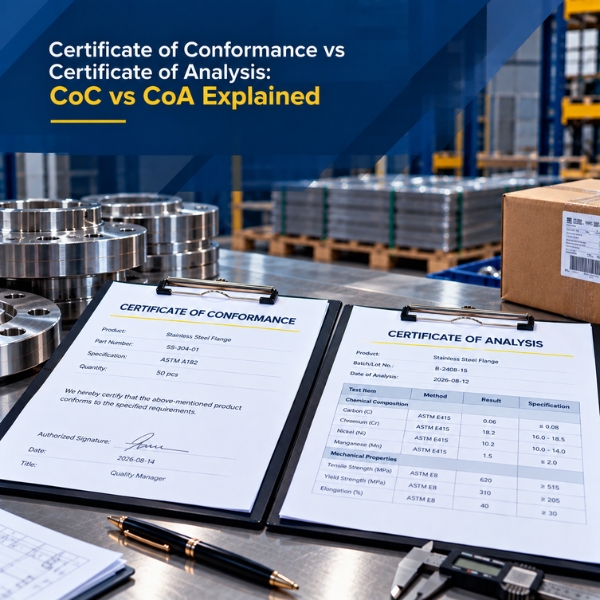
A Certificate of Conformance is a formal declaration from the manufacturer or supplier. It states that a shipment was produced to the drawing, specification, purchase order, or standard named on the document. It is an attestation and does not normally include test values.
The same document goes by other names: Certificate of Compliance, Certificate of Conformity, or Supplier's Declaration of Conformity. For consumer products regulated by the US CPSC, the formal names are General Certificate of Conformity (GCC) and Children's Product Certificate (CPC).
A usable CoC identifies the product precisely and makes a specific claim that someone can be held accountable for. At minimum, look for:
Several frameworks define what a CoC means and who can issue one.
The CPSC change matters because a consumer product CoC is no longer a document you produce only when asked. It now travels with the customs entry, so a data error can hold a shipment at the port.
A Certificate of Analysis reports measured test results for a specific lot or batch and compares each result against the specification limit for that property. Suppliers of chemicals, pharmaceuticals, food ingredients, resins, metals, and electronic materials issue CoAs routinely.
A CoA is only as valuable as its traceability. Each reported value should link back to a sample drawn from the lot you received and tested by a named method.
| Factor | Certificate of Conformance (CoC) | Certificate of Analysis (CoA) |
|---|---|---|
| What it proves | Supplier attests the product meets requirements | Measured results show the lot meets limits |
| Contains test data | Usually no | Yes, parameter by parameter |
| Scope | Shipment, order, or product line | Specific lot or batch |
| Typical issuer | Supplier quality or management | QC lab, in-house or third party |
| Common industries | Aerospace, defense, electronics, consumer goods, machined parts | Pharma, chemicals, food, resins, metals |
| Key standards | ISO/IEC 17050, FAR 52.246-15, 16 CFR 1110 | 21 CFR 211.84, ICH Q7, EN 10204 3.1 |
| Verification effort | Confirm claims and traceability | Check results, methods, limits, and lot match |
| Main risk | Unsupported claim with no data behind it | Generic or recycled data not tied to your lot |
A CoA is not automatically "better" than a CoC, because the two documents answer different questions. For a machined bracket, dimensional conformance backed by a first article report may matter more than a materials CoA. For a solvent, the CoA is the evidence that counts.
EN 10204:2004 is the clearest framework for seeing how attestation and test evidence relate to each other. Buyers of steel, aluminum, castings, and fasteners use it every day, and its certificate types map directly onto the CoC vs CoA distinction.
| EN 10204 Type | Name | What It Includes | Closest Equivalent |
|---|---|---|---|
| 2.1 | Declaration of compliance with the order | Statement only, no test results | CoC |
| 2.2 | Test report | Non-specific results (typical production data, not your lot) | Generic CoA |
| 3.1 | Inspection certificate | Specific results for the delivered product, validated by a manufacturer's inspection representative independent of production | Lot-specific CoA |
| 3.2 | Inspection certificate | Same as 3.1, also validated by the purchaser's or an official inspector | Witnessed CoA |
Watch the 2.2 row. A test report built from typical production values looks like a CoA, but it says nothing about your heat or lot. If your drawing calls for EN 10204 3.1, a 2.2 document is a nonconformance, not a substitute.
Your quality system should set certificate requirements by risk, not by habit. Requirements typically break down as follows.
AS9100D Clause 8.4.3 requires organizations to communicate requirements to external providers, including any required documentation. Buyers commonly require a CoC with every shipment. For raw stock they also require material certifications, often EN 10204 3.1 or mill certs. Federal contracts may invoke FAR 52.246-15. Counterfeit parts controls under SAE AS5553 and AS6081 add one more requirement: the CoC must trace back to the original component manufacturer.
ISO 13485:2016 Clause 7.4.3 requires verification of purchased product, scaled to supplier risk. A CoC is usually accepted for low-risk components. Critical materials usually need lot-specific CoAs. Examples include implant-grade alloys, biocompatible polymers, and parts sensitive to sterilization. For medical device supplier quality, certificate review is typically paired with periodic independent verification.
Buyers of electronics usually rely on CoCs for assembled boards and components, plus material declarations for RoHS, REACH, and PFAS. A RoHS declaration is a form of CoC. It contains no analytical results unless you request XRF screening or lab data. If you rely on chemical declarations before shipment, learn how to verify PFAS compliance before shipment.
A GCC or CPC is mandatory for products subject to a CPSC rule, ban, or standard. A CPC must be based on testing by a CPSC-accepted third-party laboratory. Since July 8, 2026, certificate data has been eFiled at entry. The certificate must now be accurate and complete enough to clear customs.
Expect a lot-specific CoA for every batch. In regulated pharma, you also need your own identity testing and a documented program for validating supplier CoAs over time.
Specify the EN 10204 type, or the equivalent mill test report, on the drawing or PO. Check that the heat numbers on the certificate match the physical heat marks on the material.
A certificate is the supplier's claim about its own product. It is useful evidence, but it is not independent evidence.
Supplier document reviews commonly turn up these failures:
A buyer orders machined aluminum brackets from a contract manufacturer. The drawing calls for 6061-T6 material with an EN 10204 3.1 inspection certificate. The shipment arrives with a clean CoC and a 3.1 mill cert, both signed and dated, and both referencing the correct PO.
An on-site inspector checks the paperwork against the factory's actual stock before the shipment leaves, and finds three problems:
None of these issues shows up on paper alone. Each document looks complete and correctly formatted. Only checking the documents against the physical material and the factory's own records exposes the gaps.
The resolution follows a standard path. The lot is quarantined, the supplier provides the correct mill cert for the material actually used, and the parts are re-measured against revision D. The supplier also receives a non-conformance report requiring a fix to how certificates are matched to material at receiving, not just a corrected certificate for this one order.
For this reason, certificate review belongs inside a wider incoming quality control process, not in place of one. For new parts or new suppliers, check certificate claims against physical results through First Article Inspections before you move to certificate-based acceptance.
ISO 9001:2015 Clause 8.6 supports this approach. Before release, it requires documented evidence that the product conforms to acceptance criteria, traceable to the person who authorized release. A supplier certificate can be part of that evidence. When risk is high, it cannot be all of it.
Use this sequence on every incoming certificate, and set the depth according to how critical the part is.
When a certificate fails any of these checks, quarantine the material. Then document the gap through your non-conformance report process. That way the supplier's corrective action fixes its documentation system, not just the one certificate.
Some issues should trigger immediate escalation rather than a routine query:
Any of these justifies an on-site check. A supplier audit can confirm whether the lab, equipment, and records behind a certificate actually exist.
Most certificate disputes trace back to vague PO language such as "certs required." Instead, specify:
Clear requirements also strengthen traceability in manufacturing. Each certificate becomes a linked record from raw material to finished product, which is exactly what you need during a recall or a customer complaint investigation.
Yes, in many cases. A CoC is an attestation, and the supplier may base it on process controls, in-process inspection, or upstream certificates. Regulated categories are the exception. CPSC children's products, for example, must be certified based on third-party lab testing.
Not exactly. An EU Declaration of Conformity is a legal document under the EU New Legislative Framework, and the manufacturer draws it up before CE marking. It covers a product type against EU directives or regulations. A commercial CoC usually covers a specific shipment against your purchase order.
The answer depends on the framework. CPSC requires certificates and supporting records to be kept for five years. Under 21 CFR 211.180, US pharmaceutical batch records must be kept for at least one year after the batch expiration date. Aerospace and medical customers often require longer periods by contract, sometimes the life of the product.
Generally yes, because the testing is independent. That only holds if the lab is accredited for the specific method and the sample was traceably drawn from your lot. A third-party report on a sample that the supplier chose and shipped proves less than it appears to.
Treat it as a measurement discrepancy. Do not automatically accept or reject the lot. Compare methods, sample preparation, and equipment calibration on both sides. If the supplier's lab and yours keep disagreeing in the same direction, stop relying on the CoA until you find the cause.
Yes, and it is common. The CoC confirms that the whole order conforms to the PO. The CoA provides measured evidence for the critical material properties. Aerospace raw material purchases often require both.
A certificate tells you what a supplier claims. AMREP confirms what is actually on the factory floor. Our teams work across Mexico, China, Vietnam, India, Thailand, Malaysia, the Philippines, and other manufacturing regions. They verify supplier documents against physical products through witness testing, lab record reviews, and on-site quality inspection services. When certificate gaps keep recurring, our supplier quality engineering team works with your suppliers to fix the documentation system behind them. Contact AMREP to set up certificate verification for your next shipment.
Contact Us To See What We Can Do
Call Us
Mon - Sat 9.00 - 18.00
Sunday Closed


12 - May 2025
12
May
2025
Malaysia is a premier manufacturing hub in Southeast Asia. According to the Malaysian Investment Development Authority (MIDA), “Malaysia, with its extensive trade....

22 - April 2025
22
April
2025
Healthcare is rapidly evolving, ensuring consistent and high-quality patient care. Total Quality Management (TQM) in healthcare is more than just a buzzword—it is a powerful....

16 - April 2025
16
April
2025
Total Quality Management (TQM) is a mindset that involves everyone in the organization working toward a common goal: achieving excellence through quality. From....


Our website uses cookies to improve your experience. Read our Cookie Policy for more information.