Guide to Qualifying New Suppliers in Malaysia for Manufacturing Success
Malaysia is a premier manufacturing hub in Southeast Asia. According to the Malaysian Investment Development Authority (MIDA), “Malaysia, with its extensive trade....

By AMREP | Posted on August 20, 2026
Incoming Quality Control (IQC) is the quality checkpoint used to verify materials, components, and products before they enter production or inventory. It helps manufacturers confirm that incoming materials meet the required specifications and are suitable for use.
An effective IQC process defines what to inspect, how much to inspect, which sampling or testing methods to use, and what to do when materials fail requirements.
In this guide, you'll learn how the IQC process works, what to include in an incoming inspection plan and checklist, how AQL sampling compares with 100% inspection, how to handle nonconforming materials, which KPIs to track, and how incoming inspection can support better supplier quality.
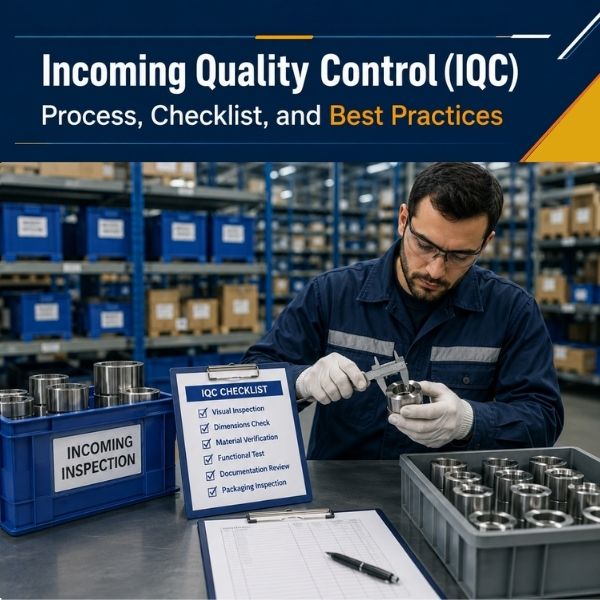
Incoming Quality Control is the process of inspecting and verifying purchased materials, components, assemblies, or products before they are accepted for production or inventory use.
The exact inspection scope depends on:
Typical IQC activities include:
For example, a machined component may require dimensional measurements, material certification, surface inspection, and thread verification. An electronic component may require part-number verification, manufacturer markings, date-code checks, packaging inspection, ESD controls, and selected electrical tests.
The objective is to verify the characteristics that matter most to quality, safety, performance, compliance, fit, reliability, and customer requirements.
These three controls operate at different points in the product lifecycle:
| Quality Stage | When It Happens | Main Purpose |
|---|---|---|
| IQC | Before production | Verify incoming materials/components |
| IPQC | During production | Control manufacturing-process quality |
| Final QC | After production | Verify finished product before release |
IQC therefore provides an early control point. However, it cannot replace process controls or final-product verification.
A well-designed IQC program can:
The goal is not to inspect more for the sake of inspection. It is to prevent meaningful failures at the earliest practical point.
A reliable IQC process should give inspectors a clear sequence while allowing inspection requirements to vary according to the product and risk.
First establish exactly what has arrived.
Verify:
The physical shipment should correspond with the purchase order, packing list, and other applicable records.
If the shipment cannot be correctly identified, it should be placed on hold until the discrepancy is resolved.
Determine whether all required supplier documentation is present and applicable to the shipment.
Depending on the product, documentation may include:
Check that the documents correspond to the actual part, material, lot, batch, or serial number being received.
A certificate belonging to a different lot does not establish conformity for the shipment under inspection.
Packaging can provide important evidence about how the material was handled during transportation and storage.
Inspect for:
Some products have specific packaging requirements. Electronics, for example, may require ESD protection, while moisture-sensitive products may require controlled packaging.
Packaging inspection should therefore be based on defined requirements rather than appearance alone.
Confirm that the lot, batch, heat number, date code, or serial number on the physical material matches the applicable documentation.
Traceability allows the organization to determine:
For materials with significant safety or performance implications, traceability can become an essential part of the quality-control system.
Before selecting samples or starting measurements, determine exactly what must be verified.
Consider:
Not every characteristic requires the same inspection effort.
For example, a safety-critical dimension may require tighter control than a cosmetic characteristic. Similarly, a new supplier may require more extensive inspection than an established supplier with a demonstrated history of conformity.
Visual inspection is commonly used for characteristics that can be evaluated without specialized testing.
Depending on the product, inspect for:
Avoid vague criteria such as “good appearance.” Instead, define what constitutes an acceptable and unacceptable condition.
For example:
No cracks, corrosion, dents affecting fit or function, or illegible identification markings are permitted.
Measure characteristics that affect:
Examples include:
Measurements should be compared against the current approved drawing or specification revision. The measurement equipment must also be appropriate for the required tolerance.
A calibrated instrument is not automatically suitable for every measurement. Resolution, accuracy, range, environmental conditions, and measurement method should all be considered.
Some requirements cannot be adequately confirmed through visual or dimensional inspection.
Depending on the product, IQC may require:
The test method and acceptance criteria should be established before testing begins. Where specialized testing is required, use qualified personnel and suitable equipment or an appropriately qualified laboratory.
An IQC record should contain enough information to reconstruct the inspection later.
Record, where applicable:
Actual measurements are generally more informative than simply recording PASS or FAIL.
For example:
Required diameter: 25.00 ± 0.05 mm
Actual result: 25.03 mm
provides considerably more information than:
Diameter: PASS
Recorded data can later be used for supplier trend analysis and process improvement.
Once inspection is complete, assign a clear status.
Accept: the material that meets the applicable requirements and may be released according to the organization's procedure.
Reject: the material that does not meet one or more applicable requirements.
Quarantine: the material which requires investigation or further review before a release decision can be made.
Approved Deviation: authorized personnel have formally approved use despite a defined deviation from the original requirement.
Disposition should always be documented.
Failed material must be prevented from accidental use.
Possible controls include:
Possible dispositions include:
For serious or recurring failures, supplier corrective action may also be required. The immediate objective is containment. The longer-term objective is preventing recurrence.
Incoming inspection should not end when the material is released or rejected.
Inspection results can be used to determine whether:
This creates a quality feedback loop:
Incoming inspection → Defect data → Supplier performance trend → Corrective action → Verification → Future inspection strategy
Incoming inspection focuses on materials and components before production begins. Once manufacturing starts, Initial Production Inspection (IPI) provides an early check that the production process is meeting the required specifications.
An IQC Inspection Plan defines what will be inspected when a particular material or component is received.
A practical inspection plan should contain:
| Element | What It Defines |
|---|---|
| Part/material | What is being inspected |
| Supplier | Who supplied it |
| Specification | Applicable technical requirement |
| Characteristics | What must be checked |
| Method | How it will be checked |
| Sampling | Number of units to inspect |
| Acceptance criteria | What constitutes conformity |
| Equipment | Measurement/test equipment |
| Frequency | When inspection is required |
| Records | Evidence to retain |
| Disposition | What happens if material fails |
The inspection plan should be prepared using the current drawing, specification, purchase requirements, risk assessment, supplier history, and applicable regulatory requirements.
It should also be reviewed whenever there is a significant change to the product, supplier, manufacturing process, specification, or defect history.
There is no single inspection level that is appropriate for every incoming shipment.
A practical decision should consider:
| Product Risk | Supplier History | Typical Control |
|---|---|---|
| High | Poor | Tightened/100% inspection + corrective action |
| High | Strong | Critical-characteristic inspection + defined sampling |
| Medium | Poor | Increased inspection + supplier action |
| Medium | Strong | Routine sampling |
| Low | Poor | Increased inspection until performance improves |
| Low | Strong | Normal/reduced inspection where approved |
| Any | New supplier | Increased initial inspection |
Incoming inspection is an important first step, but quality control should continue throughout production. For a broader approach to managing quality across the entire operation, see our guide to Total Quality Control.
Inspection should respond to evidence rather than remain permanently fixed.
Increase inspection when:
Consider reducing inspection when:
A reduction should be controlled and documented rather than based solely on an individual inspector's opinion.
Sampling is useful when inspecting every unit would be impractical, expensive, destructive, or unnecessary.
An acceptance-sampling plan establishes:
AQL, or Acceptance Quality Limit, is a parameter used within an acceptance-sampling system to index sampling schemes and associated acceptance/rejection criteria.
It should not be interpreted as a simple promise that a specified percentage of defective products is automatically acceptable in every shipment.
The current international standard is ISO 2859-1:2026, which defines AQL-indexed acceptance-sampling schemes for lot-by-lot inspection by attributes. ISO states that the 2026 edition replaces the previous 1999 edition and its amendments and introduces, among other changes, skip-lot sampling procedures and updated guidance.
In the United States, ANSI/ASQ Z1.4 remains a widely used acceptance-sampling standard for attributes inspection, with normal, tightened, and reduced plans.
Organizations should use the sampling standard specified by their customer, contract, regulatory environment, or approved quality procedure rather than selecting a sampling system informally.
AQL is part of an acceptance-sampling system, not a blanket allowance for defects. Learn more about AQL Sampling and ISO 2859 and how sampling limits are applied
A practical sampling workflow is:
Determine which units belong to the same lot based on the organization's approved definition.
Determine what the sampling inspection is intended to verify.
Safety-critical or essential characteristics may require controls beyond routine acceptance sampling.
Use the applicable ISO, ANSI/ASQ, customer, contractual, or internal procedure.
The applicable sampling plan determines the sample size based on relevant parameters such as lot size and inspection level.
The acceptance criteria must be established before inspection results are evaluated.
Avoid convenience sampling.
Where appropriate, samples should be selected so that the inspection provides a reasonable representation of the lot, including consideration of different containers, pallets, production periods, or other relevant strata.
Document:
Acceptance sampling is a statistical decision process, not proof that every uninspected item is defect-free. ASQ describes acceptance-sampling plans as specifying sample sizes and associated acceptance or nonacceptance criteria.
| Factor | 100% Inspection | Sampling |
|---|---|---|
| Coverage | Every unit | Selected units |
| Effort | High | Lower |
| Best suited to | High-risk characteristics | Controlled routine lots |
| Speed | Slower | Faster |
| Main benefit | Individual verification | Efficient resource use |
| Main limitation | Cost and time | Does not verify every unit |
100% inspection may be appropriate for:
Sampling may be appropriate for stable, controlled lots where an approved sampling plan provides suitable protection.
Defect classification helps organizations prioritize quality risks.
A condition that could create serious safety, regulatory, or essential functional consequences.
A condition that can materially affect performance, fit, usability, reliability, or an important requirement.
A lower-impact nonconformity that generally does not significantly affect intended function or safety.
The exact definitions should be established by the organization's quality procedure, product specification, customer requirement, or applicable standard.
Do not automatically assign the same AQL to critical, major, and minor characteristics. Their consequences may be substantially different.
Use the following as a starting point and adapt it to the specific material.
Different product characteristics require different verification methods.
Used for:
Uses tools such as:
Measurements are compared against specified tolerances.
May involve:
Determines whether a component performs its intended function under specified conditions.
May verify:
Used when specialized analysis is required for:
One shipment may require several inspection methods. The method should be selected according to the characteristics and the consequences of failure.
Inspection requirements should always be customized, but these examples illustrate how IQC changes according to the product.
| Material Type | Typical IQC Checks |
|---|---|
| Machined parts | Dimensions, material, threads, surface condition, markings |
| Raw materials | Grade, heat/lot number, certificate, dimensions, surface |
| Electronic components | Part number, manufacturer, markings, date code, packaging, ESD |
| Electrical assemblies | Identification, workmanship, electrical tests, documentation |
| Fasteners | Size, grade, coating, markings, certificates |
| Chemicals | Identity, lot, concentration/properties, CoA, packaging |
| Packaging materials | Dimensions, print, material, quantity, damage |
| Castings/forgings | Dimensions, surface defects, material grade, traceability |
Measurement equipment should be selected based on the characteristic and tolerance being inspected.
Consider:
For example, a basic caliper may be unsuitable for verifying a very tight tolerance when a more precise instrument or measurement system is required.
The objective is not simply to use calibrated equipment. The objective is to obtain reliable measurements appropriate to the inspection requirement.
When a shipment fails inspection, the first priority is containment.
Establish:
Possible dispositions include:
For significant or recurring problems, supplier corrective action may be required.
A useful corrective action should investigate the cause of the failure, not simply require the supplier to inspect the next shipment more carefully.
IQC becomes more valuable when inspection data is analyzed instead of being stored only as individual receiving records.
A supplier-quality feedback loop can work as follows:
Receive material
↓
Inspect and test
↓
Record defects and measurements
↓
Analyze supplier trends
↓
Initiate corrective action where needed
↓
Verify corrective action effectiveness
↓
Adjust supplier status or inspection level
For example, if a supplier repeatedly provides components with dimensional defects, the organization may:
This approach turns IQC into a source of supplier-quality intelligence rather than simply a receiving gate.
Following these practices can make incoming inspection more consistent, efficient, and useful.
Specifications, drawings, tolerances, certificates, tests, and acceptance criteria should be established before the supplier ships the material.
Inspection efforts should reflect the consequences of failure.
Supplier history and product risk should influence inspection decisions.
Inspectors should use consistent procedures, equipment, and acceptance criteria.
Ensure that equipment is suitable and within its required calibration or verification status.
Actual measurements, test results, and photographs provide more useful evidence than a simple pass/fail statement.
Rejected and pending material should be physically or electronically prevented from unintended use.
Update inspection requirements after supplier changes, product revisions, recurring defects, or process changes.
Containment protects production immediately. Corrective action addresses the underlying cause.
Review defect trends and supplier performance instead of treating each inspection as an isolated event.
IQC metrics should help management make decisions rather than simply create reports.
Measures the proportion of received lots or units rejected.
Tracks defects associated with individual suppliers.
Measures how often material passes without additional sorting or rework.
Classify failures into categories such as:
Measures how frequently previously identified defects occur again.
Measures how quickly supplier problems are addressed.
Measures how long material remains in receiving inspection before final disposition.
A useful KPI should trigger a decision. For example, an increasing repeat-defect rate may trigger supplier corrective action, while sustained strong performance may support a review of inspection frequency.
An effective record system should allow the organization to answer four basic questions:
What arrived?
What was inspected?
What was found?
Why was the material released or rejected?
Typical IQC records include:
Retention periods should follow applicable customer, regulatory, contractual, and quality-system requirements.
Records should also be controlled so that the organization can identify the applicable specification revision and inspection criteria used at the time of acceptance.
Supplier changes should be treated as potential quality risks.
Examples include:
The appropriate response depends on risk.
A significant supplier process change may justify temporary increased incoming inspection, additional testing, first-lot verification, or supplier documentation review.
This helps prevent the common assumption that a previously reliable supplier will necessarily remain unchanged after a major process modification.
IQC is one part of the broader quality-management system.
Incoming Quality Control focuses on verifying purchased materials and components.
Quality Assurance encompasses the broader systems used to provide confidence that requirements will consistently be met.
Quality assurance may include:
The distinction matters because inspection can detect a supplier problem, but inspection alone cannot guarantee that the problem will not occur again.
A mature quality system combines incoming inspection with supplier development and process control.
Once the basic process is stable, digital tools can reduce administrative effort and improve visibility.
Electronic forms make records easier to complete, retrieve, and analyze.
Scanning can reduce errors when identifying:
Photos can provide useful evidence for packaging, cosmetic, and visible defects.
Trend dashboards can identify:
Integration can automatically assign inspection requirements based on:
Where the applicable procedure allows it, strong supplier performance can support reduced inspection. Poor performance can trigger tightened controls. Technology should support the quality process, not replace sound inspection planning.
For more ways to monitor and control quality across outsourced manufacturing, see Quality Control Tools for Managing Your Outsourced Supply Chain.
A simple decision structure can help inspectors apply the process consistently.
Shipment received
↓
Is the material correctly identified and documented?
No: Hold the shipment and resolve the discrepancy.
Yes: Continue.
↓
Are the product and characteristics high risk?
Yes: Apply the required increased inspection/testing.
No: Use the approved routine inspection or sampling plan.
↓
Does the inspection meet the acceptance criteria?
Yes: Release the material.
No: Classify the defect and control the affected material.
↓
Is the failure serious, repeated, or systemic?
Yes: Initiate containment and supplier corrective action.
No: Apply the defined disposition procedure.
↓
Has supplier performance changed?
Yes: Review the inspection level and supplier status.
No: Continue the approved inspection strategy.
The key principle is that the inspection result should influence future quality controls, not only the disposition of the current shipment.
A mature IQC program can be viewed as four connected layers:
Define what the supplier must provide.
Drawing + specification + purchase order + customer requirements
↓
Determine how conformity will be established.
Inspection + testing + sampling + document review
↓
Control material that does not meet requirements.
Accept + quarantine + reject + deviation + corrective action
↓
Use results to improve supplier and inspection controls.
Trend analysis + supplier corrective action + inspection adjustment
This structure prevents IQC from becoming a purely administrative receiving activity.
Before implementing or reviewing an IQC program, verify that:
Not automatically. The decision depends on product risk, supplier capability, contractual requirements, customer expectations, and the organization's approved procedure. Certain characteristics may still require independent verification.
Start with the engineering specification, intended use, customer requirements, regulatory requirements, failure consequences, and historical defects. Characteristics affecting safety, essential function, fit, reliability, or compliance generally deserve greater attention.
Where appropriate, yes. Purchase documents can establish the applicable specification, revision, testing, certificates, and other acceptance requirements before the material is shipped.
Review the applicable specification, inspection method, equipment, sample identification, and objective results. If necessary, involve engineering or use an agreed independent test method.
Potentially, if its approved procedure permits reduced inspection and objective performance data supports the change. The decision should also consider product risk and customer or regulatory requirements.
First contain the affected material. Then determine whether additional inspection, supplier corrective action, supplier reassessment, or a temporary change in inspection level is necessary.
A nonconformity is a failure to meet a specified requirement. A defect generally refers to a condition that makes a product unsuitable for its intended or reasonably foreseeable use. The exact terminology should follow the applicable quality standard or organizational procedure..
A well-designed IQC program gives manufacturers more than a receiving inspection record. For organizations managing multiple suppliers, complex inspection requirements, or recurring quality issues, formalizing this process can make supplier-quality decisions more consistent and measurable.
AMREP's Supplier Management Services can help organizations establish effective supplier-quality controls, improve supplier performance, and strengthen broader quality-management objectives. Explore AMREP's quality management solutions to build a more consistent and reliable supply chain.
Contact Us To See What We Can Do
Call Us
Mon - Sat 9.00 - 18.00
Sunday Closed


12 - May 2025
12
May
2025
Malaysia is a premier manufacturing hub in Southeast Asia. According to the Malaysian Investment Development Authority (MIDA), “Malaysia, with its extensive trade....

22 - April 2025
22
April
2025
Healthcare is rapidly evolving, ensuring consistent and high-quality patient care. Total Quality Management (TQM) in healthcare is more than just a buzzword—it is a powerful....

16 - April 2025
16
April
2025
Total Quality Management (TQM) is a mindset that involves everyone in the organization working toward a common goal: achieving excellence through quality. From....


Our website uses cookies to improve your experience. Read our Cookie Policy for more information.