Guide to Qualifying New Suppliers in Malaysia for Manufacturing Success
Malaysia is a premier manufacturing hub in Southeast Asia. According to the Malaysian Investment Development Authority (MIDA), “Malaysia, with its extensive trade....

By AMREP | Posted on November 3, 2026
Published: November 3, 2026 | Last reviewed: November 3, 2026
To find a reliable sourcing agent in Thailand, shortlist agents who already work in your product category. Then check that each one is registered with the Department of Business Development (DBD), discloses how it gets paid, names the factory before you pay a deposit, gives references you can call, and accepts independent inspection. Compare the agents who pass on a scorecard, then test the strongest one with a trial order before you commit to volume.
Your agent controls which factories you see, what prices reach you, and often who approves quality. That is too much control to hand over without verification.
This guide covers agent roles, how to spot trading companies, where to find agents, a six-step verification process, fees, shortlisting questions, red flags, contract terms, trial orders, and independent inspection.
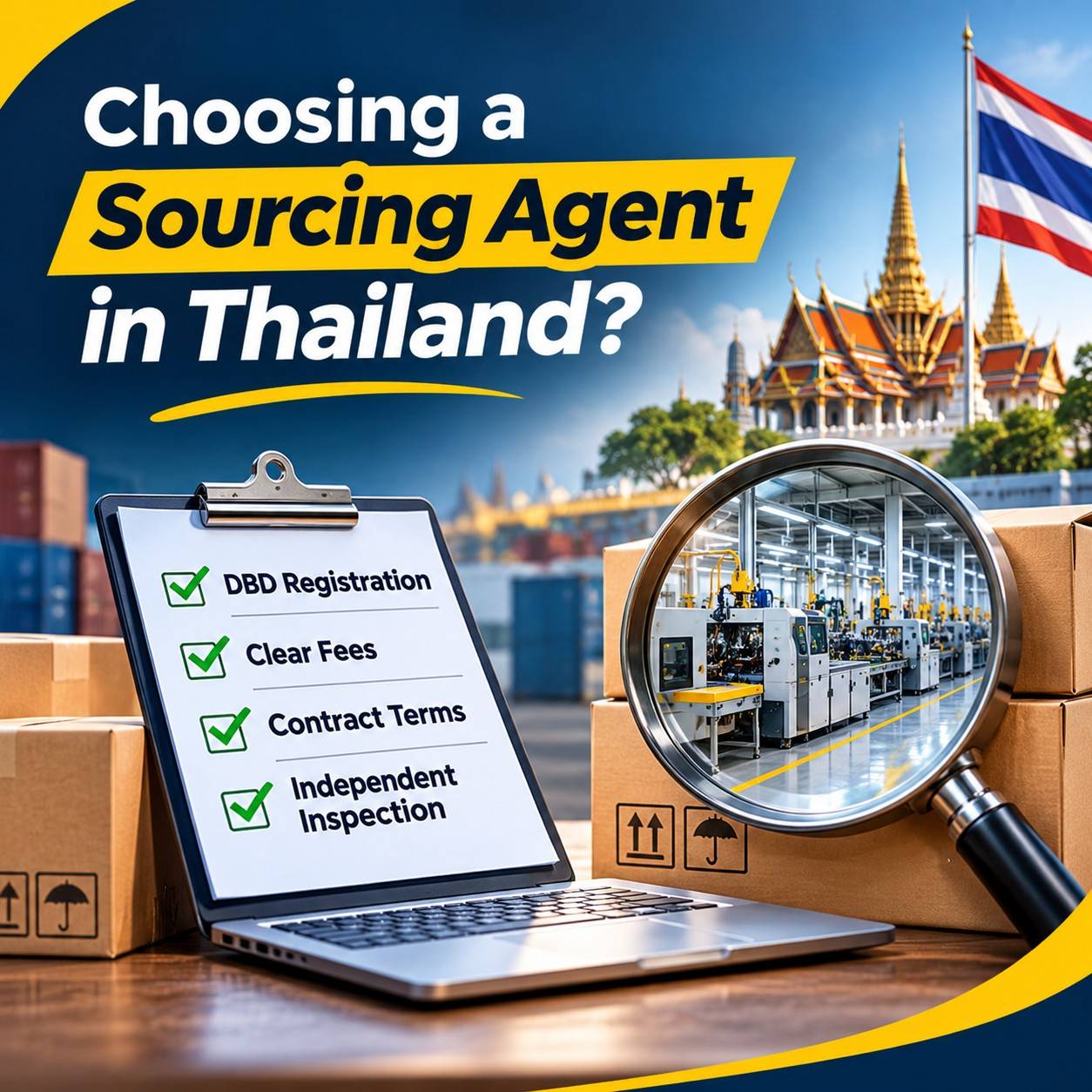
A sourcing agent represents you on the ground in Thailand. The role usually includes:
Communication deserves a closer look. Thai business culture places weight on kreng jai, a value centered on avoiding imposing on others or causing discomfort. In practice, a factory may hesitate to report a delay or defect directly, and an agent who shares that norm may soften bad news before it reaches you. A good agent knows how to surface problems early without damaging the relationship.
Where agents tend to be weaker is technical quality judgment. Many have strong commercial and language skills but limited training in audit methods, sampling plans, or product standards. Their incentives also run toward closing orders, not stopping them.
| Task | Typical agent role | Needs a qualified auditor or lab |
|---|---|---|
| Supplier search and shortlisting | Yes | No |
| Price and MOQ negotiation | Yes | No |
| Sample coordination | Yes | Sample testing may |
| Factory capability and system audit | Sometimes, informally | Yes |
| Standards compliance (ISO, IATF, RoHS, TISI) | Rarely | Yes |
| AQL-based inspection | Sometimes | Yes, for objective results |
| Final accept or reject decision | Often, in practice | Should be independent |
Three types of businesses offer "sourcing" in Thailand, and they work very differently.
A true agent works for you, names the factory, and earns a disclosed fee or commission. You contract with the factory directly, or the agent manages that contract on your behalf in a transparent way.
A trading company buys from the factory and resells to you at a markup. That is a legitimate business model, but it becomes a problem when it is presented as agency work. You lose visibility into the real factory, the real price, and in some cases the real country of origin.
Forwarders are strong on logistics, customs, and shipping. Some offer supplier search as an extra service. Their sourcing depth varies widely, and quality control is usually outside their core expertise.
Ask for these three things before you sign anything:
| Factor | Sourcing agent | Trading company | Freight forwarder |
|---|---|---|---|
| Who owns the factory relationship | You | The trader | Varies |
| How they earn | Disclosed fee or commission | Margin on resale | Freight fees, plus sourcing fee |
| Factory identity disclosed | Yes | Rarely | Usually |
| Best fit | Custom or repeat production | Small mixed orders | Buyers with simple products and a logistics focus |
Each channel produces a different quality of lead.
| Channel | Examples | Lead quality |
|---|---|---|
| Government and trade bodies | DITP and Thai Trade Centers abroad, Thai Chamber of Commerce, Federation of Thai Industries, AMCHAM Thailand, EABC, Thailand Board of Investment | Partially screened |
| Industry trade fairs | Manufacturing Expo and METALEX (industrial and automotive), THAIFEX-Anuga Asia (food), Bangkok Gems and Jewelry Fair, BIG+BIH (gifts and home goods) | Strong, since you meet agents and factories in the same week |
| Referrals | Freight forwarders, customs brokers, inspection firms | Often the strongest, because referrers see shipment outcomes |
| Freelance platforms and B2B directories | Upwork, Fiverr, LinkedIn, ThaiTrade, global B2B marketplaces | Raw and unverified |
Confirm current fair dates on each organizer's site before planning travel. Treat platform ratings with care: they measure satisfaction with communication, not whether the agent's factories passed inspection.
Location matters too. Agents based near your product's industrial cluster can visit factories more often. Automotive, electronics, and petrochemical suppliers are concentrated in the Eastern Economic Corridor (Chonburi, Rayong, Chachoengsao) and the industrial provinces around Bangkok. Handicrafts, furniture, and home decor are common around Chiang Mai. Rubber and seafood processing are strong in the south. Ask each agent where their staff are based and how often they visit factories in person.
This process takes a few hours of desk work and one site check. It filters out many unreliable agents before you risk a deposit, and the same steps work when you need to verify a Thai supplier directly. It also helps to know what to check before signing a new manufacturer, since your agent's recommended factories need the same scrutiny.
The Department of Business Development, under Thailand's Ministry of Commerce, maintains the official company registry. Search the DBD DataWarehouse by company name or by the 13-digit juristic person registration number, in Thai or English. Check:
A company registered a few months ago, or one whose objective has nothing to do with sourcing, deserves closer questioning.
Ask the agent for a recent company affidavit (certificate of registration) issued by the DBD, along with the shareholder list (Bor Or Jor 5). English-language certificates are available through DBD e-Service. Compare the names and signatories against what you found online.
For Thai companies, the tax identification number normally matches the 13-digit registration number. Ask for the VAT registration certificate (Por Por 20) and confirm that the company name on your contract, the VAT certificate, and every invoice is identical. A mismatch can signal payment diversion or an undisclosed intermediary.
Under the Foreign Business Act B.E. 2542 (1999), a company is generally treated as foreign when half or more of its shares are held by non-Thai persons, which restricts the activities it may carry out. Some foreign-run agencies use Thai nominee shareholders to work around this. That is illegal, and it puts your supply chain at risk if the company is investigated. If the shareholder list shows Thai holders with no visible role while a foreign national runs the business, ask how the company is structured.
Ask for references who import the same type of product you do. Call them yourself. Ask what went wrong on their last order and how the agent handled it. An agent with no references in your category is learning on your budget.
If you can travel, visit the registered address. If you cannot, use one or more remote options:
Live and unannounced checks carry more weight than pre-recorded videos or photos sent by the agent.
The fee model shows whose interests the agent serves. Ask for it in writing before any work begins.
Published pricing guides from Asia-focused sourcing firms put commission rates at roughly 3 to 15 percent of order value, with most full-service agents between 5 and 10 percent, and fixed project fees from about USD 500 for a simple search to several thousand dollars for end-to-end management. Smaller orders usually carry higher percentages. These are regional benchmarks, not Thailand-specific rates, so use them to sense-check quotes rather than as fixed prices.
The agent earns a percentage of each order. It is simple and scales with volume, but it rewards larger orders, not better ones. An agent on commission has little reason to recommend stopping a shipment.
You pay a set amount for supplier search, a project, or ongoing management. This separates the agent's income from order size and suits buyers with steady volume or complex products.
The agent quotes you a unit price that already includes their margin. You cannot see the factory price, which makes it impossible to judge whether you are paying fairly.
Some agents collect a commission from the factory as well as from you, or only from the factory while claiming to work for free. This is the model that causes the most damage, because the agent is effectively working for the supplier. Your contract should rule it out explicitly.
Use the first call to test both general competence and category fit.
An agent who sources furniture well may know little about automotive parts. Ask questions that match your product's standards and regulations.
| Industry | What to ask the agent |
|---|---|
| Automotive parts | Do your suppliers hold IATF 16949 certification? Have you managed PPAP submissions? |
| Electronics and electrical | Can suppliers provide RoHS and REACH documentation for EU-bound goods? Do products sold in Thailand need TISI certification? |
| Food and agricultural products | Do suppliers hold GMP and HACCP certification? Are products registered with the Thai FDA where required? |
| Rubber products and medical gloves | Which ISO, ASTM, or EN standards do suppliers test to, and which labs issue the reports? |
| Furniture and home goods | How do suppliers document wood species, finishes, and moisture content? Have their products passed destination-market safety tests? |
If an agent cannot answer these for your category, they will struggle to catch problems before your goods ship.
Once two or three agents pass verification, score them side by side. The weights below are a starting point. Adjust them to your product's risk level.
| Criterion | Weight | What a 5 out of 5 looks like |
|---|---|---|
| Category experience and references | 25% | Recent orders in your exact product type, with references who confirm results |
| Registry and ownership verified | 20% | Active DBD record, matching invoicing entity, clear ownership |
| Fee transparency | 20% | Written fee model and a signed no-supplier-payment statement |
| Quality capability and openness to inspection | 20% | Named QC staff, a defined sampling standard, and full support for third-party checks |
| Communication and responsiveness | 15% | Clear written updates, fast replies, and willingness to report bad news early |
Score each criterion from 1 to 5, multiply by the weight, and total the results. A strong score on price alone should never outweigh weak scores on verification or quality.
Walk away, or slow down sharply, if you see any of these:
A written agreement turns the answers you heard on the first call into enforceable terms.
Define the services, product categories, and regions covered. State whether the arrangement is exclusive, and for how long.
Write down the full fee structure and include a clause confirming the agent receives no payment, gift, or commission from any supplier. Give yourself the right to terminate if this is breached.
Require full factory names and addresses before orders are placed, and confirm your right to contact and visit factories directly.
Cover drawings, specifications, and samples under confidentiality terms. State clearly that molds, dies, and tooling you pay for belong to you, and require their return on request.
Tie acceptance to measurable criteria, including AQL levels and your product specifications. Note that ISO 2859-1 was revised in January 2026, so confirm which edition your inspection plans reference. Confirm that independent inspection results are binding. If you are setting these for the first time, learn how to apply AQL sampling under ISO 2859 before production starts.
Use a Thai and English contract, and state which version prevails. Choose governing law and a dispute forum, such as Thai courts or arbitration through the Thai Arbitration Institute or the Thailand Arbitration Center.
Include a trial period tied to your first order. State what happens when the agreement ends, including whether you can keep buying from factories the agent introduced, and on what terms.
This section is general information, not legal advice. Have a lawyer licensed in Thailand review the agreement before signing.
A trial order is the most reliable test of an agent, because it shows how they perform when real money and deadlines are involved.
An agent who performs well under independent inspection on a trial order is far more likely to perform well at scale.
Reliability shows up over time. Track a few measures from the first order and review them with the agent on a fixed schedule, such as quarterly.
| Measure | What it tells you |
|---|---|
| On-time shipment rate | Whether the agent manages production schedules effectively |
| First-pass inspection rate | Whether the agent's factory choices and follow-up actually deliver quality |
| Cost variance against quote | Whether pricing stays transparent after the first order |
| Response time to issues | Whether problems reach you early or late |
| Corrective action closure time | Whether the agent follows through after defects are found |
The same discipline applies to the factories themselves. To build a broader system, evaluate supplier performance using defined metrics and a regular review cycle.
In practice, the final accept or reject decision often sits with the agent. That creates a structural conflict, even when the agent is honest and skilled. Their income depends on orders shipping, so a borderline lot puts pressure on them to pass it. Independent inspection takes that pressure out of the decision.
Independent checks fit at these points:
On your trial order, book an initial production inspection to see how your agent and factory perform under independent review. For high-value shipments, add container loading supervision to confirm that what passed inspection is what actually ships.
AMREP supplier management services provide supplier audits, production inspections, and pre-shipment checks across its multi-region footprint, including Thailand. If you are qualifying a new agent or factory, explore AMREP’s quality inspection services in Thailand or request a supplier audit so your first order ships on verified quality, not on trust alone.
You can work directly with many Thai factories, especially larger exporters in automotive, electronics, and food processing that have English-speaking sales teams. An agent adds the most value when you need custom production, manage several suppliers, or cannot visit Thailand regularly. Either way, independent inspection still applies.
Generally, yes. Buying goods from Thailand and contracting a Thai company for sourcing services does not usually require you to register a business in Thailand, since the agent is the party operating locally. Check your own home-country tax and import obligations, and confirm specifics with a qualified advisor.
It depends on product complexity. Catalog products with minor changes move fastest. Custom products with new tooling, multiple sample rounds, or certification testing take considerably longer. Ask the agent for a written timeline that covers supplier search, sampling, testing, and first production.
An NNN agreement written in Thai and English, governed by Thai law, and enforceable in Thai courts gives you stronger protection than a generic NDA. Thailand's Trade Secrets Act B.E. 2545 (2002) also applies. Because IP rights are territorial, register key trademarks and designs in Thailand as well.
It depends on your agreement. Some contracts include non-circumvention clauses that restrict direct dealing with introduced factories for a set period. Negotiate this before signing, and keep factory disclosure and direct-contact rights in the contract.
Thailand typically suits automotive parts, electrical goods, processed food, rubber products, and jewelry, where its supplier base is well established. Vietnam is a common choice for apparel, footwear, and furniture. Compare both on your product's certifications, supplier depth, and the trade agreements that apply in your destination market.
A deposit, often around 30 percent, with the balance paid before shipment is common for new relationships. To reduce risk, tie the balance payment to a passed pre-shipment inspection report, or use a letter of credit for larger orders.
Contact Us To See What We Can Do
Call Us
Mon - Sat 9.00 - 18.00
Sunday Closed

12 - May 2025
12
May
2025
Malaysia is a premier manufacturing hub in Southeast Asia. According to the Malaysian Investment Development Authority (MIDA), “Malaysia, with its extensive trade....

22 - April 2025
22
April
2025
Healthcare is rapidly evolving, ensuring consistent and high-quality patient care. Total Quality Management (TQM) in healthcare is more than just a buzzword—it is a powerful....
16 - April 2025
16
April
2025
Total Quality Management (TQM) is a mindset that involves everyone in the organization working toward a common goal: achieving excellence through quality. From....


Our website uses cookies to improve your experience. Read our Cookie Policy for more information.