Guide to Qualifying New Suppliers in Malaysia for Manufacturing Success
Malaysia is a premier manufacturing hub in Southeast Asia. According to the Malaysian Investment Development Authority (MIDA), “Malaysia, with its extensive trade....

By AMREP | Posted on March 14, 2026
ISO 13485 defines requirements for quality management systems in the medical device industry, and ISO 14644 establishes the standards for cleanrooms and controlled environments. While each standard focuses on a different aspect of operational compliance, they are deeply interconnected in industries where product quality depends on controlled manufacturing environments.
Conducting integrated audits that evaluate both ISO 13485 and ISO 14644 enables organizations to streamline compliance efforts, minimize operational disruptions, and ensure strong alignment between quality management systems and environmental control processes. Instead of assessing these standards independently, integrating them within a unified audit framework provides more understanding of how quality practices and cleanroom operations work together. This approach enhances oversight, improves efficiency, and strengthens overall regulatory readiness.
This article explores the relationship between ISO 13485 and ISO 14644, the benefits of integrated audits, and how organizations can successfully combine these standards during the auditing process.
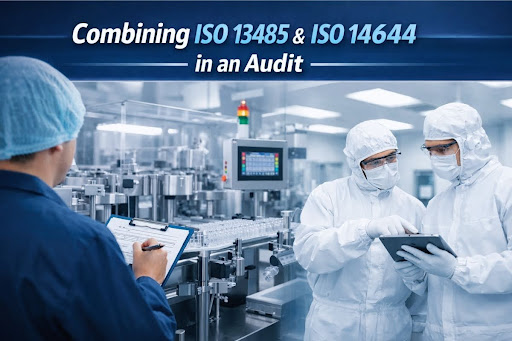
Before exploring how these standards can be combined in an audit, it is important to understand their individual roles and objectives.
ISO 13485 is an internationally recognized standard that defines the requirements for Quality Management Systems (QMS) in the medical device industry. The standard focuses on ensuring that organizations consistently meet regulatory requirements and maintain the highest levels of product safety and effectiveness.
ISO 13485 covers a wide range of quality management processes, including:
The goal of ISO 13485 is to ensure that medical devices are designed, manufactured, and distributed in a way that consistently meets both regulatory and customer requirements.
Organizations implementing ISO 13485 must establish documented procedures and controls that demonstrate their ability to maintain consistent product quality throughout the product lifecycle.
While ISO 13485 focuses on quality management systems, ISO 14644 addresses the environmental conditions required to support sterile and contamination-sensitive processes.
ISO 14644 provides a comprehensive framework for cleanroom classification, design, operation, monitoring, and testing. The standard defines the allowable levels of airborne particles in controlled environments and outlines procedures for maintaining those conditions.
Key elements of ISO 14644 include:
Cleanrooms play a critical role in industries where contamination can compromise product quality or patient safety. In medical device manufacturing, pharmaceutical production, and biotechnology research, maintaining controlled environments is essential to prevent microbial and particulate contamination.
Although ISO 13485 and ISO 14644 address different operational areas, they are closely linked in industries where contamination control directly affects product quality and regulatory compliance.
For example, a medical device manufacturer producing sterile implants must not only demonstrate that its quality management system meets ISO 13485 requirements but also prove that its cleanroom environment meets ISO 14644 standards.
These standards intersect in several important areas:
ISO 13485 requires organizations to maintain controlled manufacturing processes. In many cases, this includes operating within cleanroom environments defined by ISO 14644.
Contamination risks must be identified and controlled within the quality management system. Cleanroom performance plays a critical role in mitigating these risks.
Environmental monitoring programs required by ISO 14644 support quality assurance processes outlined in ISO 13485.
Production processes carried out in cleanrooms must be validated to ensure consistent performance and contamination control.
Because these elements are interconnected, auditing them separately can create gaps in oversight and inefficiencies in compliance management.
Conducting integrated audits that evaluate both standards simultaneously offers several strategic advantages for regulated organizations.
Organizations in regulated industries often face multiple internal and external audits each year. Combining ISO 13485 and ISO 14644 assessments can significantly reduce the number of separate audits required.
This helps minimize operational disruptions and reduces the administrative burden on quality and compliance teams.
Integrated audits allow organizations to evaluate how quality management systems and cleanroom operations interact in practice.
Instead of reviewing documentation and environmental performance separately, auditors can examine how procedures, monitoring systems, and operational controls work together to support contamination control.
Managing multiple standards independently can lead to duplicate documentation, overlapping procedures, and inconsistent processes.
Combining audits encourages organizations to integrate their compliance activities, improving efficiency and simplifying regulatory management.
Integrated audits provide a more comprehensive view of contamination risks across the organization.
By evaluating both quality systems and environmental controls together, auditors can identify gaps that might otherwise go unnoticed.
Conducting combined audits allows organizations to optimize the use of internal resources, including quality personnel, technical staff, and cleanroom specialists.
This leads to more efficient audit preparation and improved use of compliance budgets.
When combining ISO 13485 and ISO 14644 audits, several operational areas are typically evaluated to ensure alignment between quality management systems and cleanroom controls.
Auditors review cleanroom classification levels and confirm that they meet the requirements for the specific manufacturing processes being performed.
This includes verifying airflow systems, filtration efficiency, and environmental monitoring practices.
Environmental monitoring systems are critical for maintaining cleanroom compliance.
Auditors assess monitoring procedures, sampling frequencies, alert limits, and corrective actions taken when deviations occur.
Processes performed in cleanrooms must be validated to demonstrate consistent performance and contamination control.
Integrated audits evaluate how validation procedures are documented and maintained within the quality management system.
Both standards require detailed documentation of procedures, testing results, monitoring data, and corrective actions.
Auditors verify that records are properly maintained, controlled, and accessible.
Employees working in cleanroom environments must receive specialized training in contamination control, gowning procedures, and cleanroom behavior.
Auditors review training records to ensure personnel competency.
Integrated audits also examine how organizations identify, investigate, and resolve quality issues related to environmental conditions.
This includes reviewing corrective action processes and root cause analysis procedures.
Organizations that plan to conduct integrated audits should follow a structured preparation process.
A gap analysis helps identify differences between current practices and the requirements of both standards.
This process allows organizations to address weaknesses before the audit begins.
Procedures related to cleanroom operations, environmental monitoring, and contamination control should be integrated within the quality management system.
This ensures consistency across operational processes.
Organizations should verify that monitoring programs meet ISO 14644 requirements and are properly integrated into quality management procedures.
Staff members should understand both quality management requirements and cleanroom operating procedures.
Regular training ensures employees follow best practices in contamination control.
Internal audits allow organizations to identify potential compliance issues before external auditors arrive.
These audits should simulate the combined approach used during integrated assessments.
While combining ISO 13485 and ISO 14644 audits offers significant benefits, organizations may face certain challenges during implementation.
Common challenges include:
Organizations can overcome these challenges by working with experienced compliance consultants and cleanroom specialists.
Organizations should also ensure that supplier certifications are legitimate. Our guide How to Verify an ISO Certified Company : Practical Verification Steps provides practical methods for validating ISO certification claims.
Navigating multiple regulatory standards can be complex, particularly in industries where environmental control directly impacts product safety.
Expert consultants and compliance specialists can help organizations:
Professional support ensures that organizations remain prepared for evolving industry standards.
To better understand the foundation of quality management standards, you can also explore our guide ISO 9000 vs ISO 9001: What’s the Difference?, which explains how these two standards relate to each other.
As regulatory expectations continue to evolve, organizations must adopt integrated approaches to quality management and contamination control. Combining ISO 13485 and ISO 14644 audits allows businesses to streamline compliance efforts while ensuring that both quality systems and cleanroom environments operate effectively.
Through its Expert Auditing Services, AMREP Mexico supports organizations in regulated industries by providing guidance in cleanroom compliance, contamination control, and quality management system integration. From cleanroom validation and environmental monitoring to audit preparation and regulatory support, AMREP Mexico helps companies navigate complex standards with confidence.
By partnering with experienced compliance specialists, organizations can improve operational efficiency, strengthen regulatory readiness, and ensure that their cleanroom and quality systems meet international standards.
Contact Us To See What We Can Do
Call Us
Mon - Sat 9.00 - 18.00
Sunday Closed


12 - May 2025
12
May
2025
Malaysia is a premier manufacturing hub in Southeast Asia. According to the Malaysian Investment Development Authority (MIDA), “Malaysia, with its extensive trade....
22 - April 2025
22
April
2025
Healthcare is rapidly evolving, ensuring consistent and high-quality patient care. Total Quality Management (TQM) in healthcare is more than just a buzzword—it is a powerful....

16 - April 2025
16
April
2025
Total Quality Management (TQM) is a mindset that involves everyone in the organization working toward a common goal: achieving excellence through quality. From....


Our website uses cookies to improve your experience. Read our Cookie Policy for more information.