Guide to Qualifying New Suppliers in Malaysia for Manufacturing Success
Malaysia is a premier manufacturing hub in Southeast Asia. According to the Malaysian Investment Development Authority (MIDA), “Malaysia, with its extensive trade....

By AMREP | Posted on August 21, 2026
A Factory Acceptance Test (FAT) is a formal inspection and functional test of equipment or machinery at the manufacturer's facility, performed before shipment, to confirm it meets the buyer's specifications and applicable safety standards. It gives buyers documented proof that equipment works before it leaves the factory, and it is distinct from a Site Acceptance Test (SAT), which verifies the same equipment after installation.
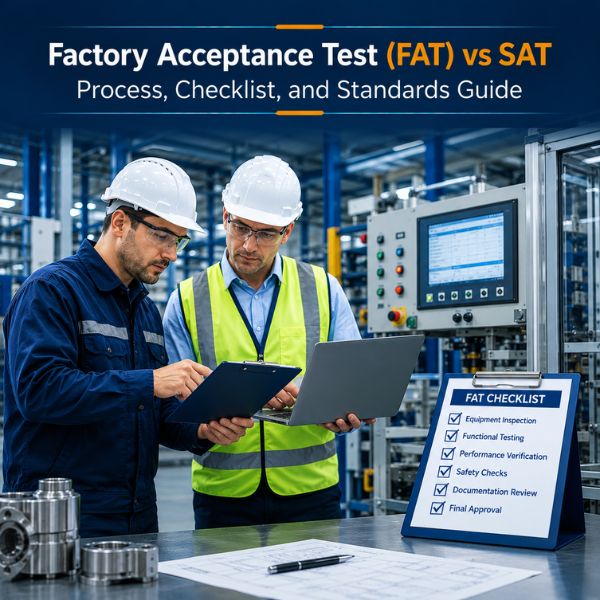
A FAT verifies that equipment, a machine, or an automated system performs as designed before it leaves the supplier's factory. Unlike a standard product inspection, which checks a sample against a specification sheet, a FAT runs the actual equipment through its full operating sequence: power-up, functional cycles, safety interlocks, and performance under load, with the buyer's team present or reviewing the results directly.
FAT is standard practice for capital equipment: automation lines, CNC machinery, robotic work cells, control panels, test stands, and packaging or assembly equipment. It is less common for simple components or consumer goods, where a pre-shipment inspection is the more typical checkpoint.
A successful FAT results in a signed acceptance document. That signature usually triggers a milestone payment and starts the shipping and installation clock, which is why buyers treat FAT as a contractual gate, not just a quality check.
Equipment defects caught after installation are far more expensive to fix than defects caught at the factory. Once a machine is crated, shipped, and installed on your production floor, correcting a wiring error, a software bug, or an undersized component means downtime, a technician flight, and a delayed production start, on top of the original defect.
FAT shifts that risk back to the factory, where the supplier's engineers, spare parts, and tools are already on hand. It also creates a documented record of what was tested and what passed, which protects the buyer if a dispute over performance comes up later.
For OEMs and industrial buyers sourcing equipment from overseas suppliers, FAT is often the only opportunity to physically verify the machine before it becomes difficult and expensive to inspect again.
Schedule a FAT once the equipment is fully assembled, wired, and functionally complete, but still at the factory. In practice, that means:
Scheduling FAT too early, before the equipment is functionally complete, produces a test full of unresolved issues that aren't representative of final performance. Scheduling it too late leaves no time to fix problems without delaying shipment.
The FAT protocol is the written test plan both parties agree to before testing begins. Without it, "pass" and "fail" become a negotiation on the test floor instead of a documented outcome. A complete protocol includes:
Buyers who skip a written protocol and rely on a verbal walkthrough are the ones most likely to end up in a dispute over whether the equipment "actually" passed.
| Category | What to Verify |
|---|---|
| Documentation | Drawings, wiring diagrams, BOM, software version, calibration certificates match the as-built equipment |
| Mechanical & Structural | Frame integrity, alignment, fasteners, welds, finish, and correct components installed |
| Electrical & Controls | Panel wiring, labeling, grounding, and conformance to the specified electrical standard |
| Safety Systems | E-stops, interlocks, light curtains, guarding, and lockout/tagout points function correctly |
| Functional Performance | Cycle times, throughput, accuracy, and repeatability meet the agreed specification |
| Software & HMI | Screens, alarms, fault handling, recipes, and data logging operate as specified |
| Load & Endurance | Equipment sustains performance under rated load or over an extended run, where specified |
| Utilities & Consumables | Power, air, and other utility requirements match what was quoted and what's available on site |
| Spare Parts & Manuals | Recommended spares list, operation manuals, and maintenance documentation are complete |
| Punch List | All deficiencies are logged with an owner, a resolution deadline, and sign-off criteria |
A FAT is more effective with the right people in the room, whether in person or reviewing remotely.
When travel isn't practical, a live video FAT with a local third-party inspector on-site is a common alternative. The inspector operates as the buyer's eyes and hands at the factory, running the physical checks while the buyer's team observes and directs remotely.
FAT protocols are typically built around a mix of the buyer's own specifications and recognized industry standards, which give both parties an objective reference instead of subjective judgment calls.
Which standards apply depends on the equipment and its destination market. Building the relevant standard into the FAT protocol upfront, rather than discovering a gap during the test, avoids last-minute disputes over what "compliant" actually means.
A Site Acceptance Test verifies that equipment which already passed FAT performs correctly after it's shipped, installed, and connected to the buyer's actual facility: real power and air supply, real upstream and downstream equipment, and real production materials. SAT answers a different question than FAT. FAT asks whether the equipment works as built. SAT asks whether it works here.
SAT typically follows this sequence:
SAT is usually run by the buyer's operations and maintenance team, with the supplier's commissioning engineer present, and it typically takes one to several days depending on integration scope. It's the milestone that starts the warranty period. Because it happens in a live production environment, SAT surfaces problems FAT can't: utility mismatches, layout conflicts, software integration issues with existing plant systems, and gaps in operator training.
FAT and SAT are sequential, not interchangeable. FAT proves the equipment works at the factory; SAT proves it still works, and works correctly, once it's installed in your actual production environment.
| <br> | Factory Acceptance Test (FAT) | Site Acceptance Test (SAT) |
|---|---|---|
| Location | Supplier's factory | Buyer's facility |
| When | Before shipment | After installation and integration |
| Question answered | Does the equipment perform to specification as built? | Does the equipment perform correctly in its actual operating environment? |
| Conditions tested | Standalone, using factory power, air, and test fixtures | Integrated with real utilities, upstream/downstream equipment, and production materials |
| Typical issues found | Build defects, wiring errors, software bugs, missing components | Integration conflicts, utility mismatches, environmental factors, operator interface gaps |
| Who's usually present | Buyer's engineers, supplier's team, sometimes a third-party inspector | Buyer's operations and maintenance staff, supplier's commissioning engineer |
| Typical duration | Hours to several days, by complexity | One to several days, by integration scope |
| Outcome | Shipping and payment milestone release | Final handover and start of the warranty period |
Skipping FAT and relying only on SAT means the first time you learn about a defect, the equipment is already installed and the supplier's engineers are no longer on-site. Skipping SAT and relying only on FAT means you never confirm the equipment behaves correctly once it's connected to your real production line, which is where integration problems typically surface.
FAT and commissioning are frequently confused, but they happen at different stages and cover different scopes. FAT is a discrete, time-boxed test event, typically hours to a few days, that either passes, fails, or passes with a punch list. Commissioning is the broader, ongoing process of bringing equipment into full operational readiness: fine-tuning process parameters, running production trial batches, calibrating to actual materials, and training operators over days or weeks after installation.
In practice, FAT happens once, at the factory, before shipment. SAT is the acceptance checkpoint after installation. Commissioning is the surrounding process that includes SAT but extends beyond it, continuing until the equipment is reliably running production at target rates. A machine can pass both FAT and SAT and still take additional weeks of commissioning to reach stable, full-rate production.
Buyers sourcing both capital equipment and manufactured parts sometimes use FAT interchangeably with other validation methods that sound similar but serve a different purpose.
A pre-shipment inspection checks a statistical sample of finished, packaged product against a specification, using sampling standards like AQL, shortly before the goods ship. It's built for repeatable, produced-in-volume goods. FAT tests a single piece of equipment, or a small number of identical units, through its full functional sequence rather than sampling a batch. It's built for capital equipment where every unit needs to be individually proven, not statistically sampled.
First Article Inspection validates that the first part or subassembly off a new or modified production process conforms to the engineering drawing, before that process runs at volume. It's a check on the part and the process that makes it. FAT validates a piece of equipment or machinery itself, before it ships, not the parts that equipment will eventually produce.
The Production Part Approval Process (PPAP) is a documentation-heavy approval process, common in automotive and aerospace, that proves a supplier's production process can consistently produce conforming parts over time. It's a process capability approval for parts. FAT is a one-time functional test of the equipment itself, run before that equipment ever produces a part.
FAT and SAT costs are driven primarily by engineer time and travel, not the test itself. A single FAT typically runs from one inspector or engineer man-day for a simple, single-station machine to several man-days for a multi-station automation line with extensive load and endurance testing. Using a local third-party inspector at the supplier's factory is usually less expensive than flying an internal engineer overseas, since it removes airfare, lodging, and multi-day travel time from the cost.
SAT costs follow a similar pattern but tend to run longer, since integration testing and operator training add time that a standalone FAT doesn't require. Buyers should also budget for the supplier's commissioning engineer time if the contract requires the supplier's presence during SAT, which is common for complex or first-of-type equipment.
The cost of either test is small relative to the cost of discovering the same defect after installation, which typically adds technician travel, production downtime, and schedule delay on top of the original repair.
In Vietnam, a buyer's FAT protocol caught a hidden interlock bypass because it required triggering fault conditions, not just watching a normal cycle. In Mexico, a protocol that specified cycle time but not changeover time missed a costly gap that only surfaced after installation.
The pattern in both cases repeats across most FAT failures:
Anywhere from a few hours for a simple machine to several days for a complex, multi-station automation line. Complexity and the number of test cases drive the timeline, not equipment size alone.
This varies by contract. Some buyers send their own engineers at their own cost; others use a local third-party inspector, which is often cheaper than flying an internal engineer to the supplier's country.
Yes, through a live video FAT, often with a local third-party inspector performing the physical checks while the buyer's team observes and directs in real time.
The supplier corrects the deficiencies and the affected tests are repeated, either in full or for just the failed items, before sign-off and shipment proceeds.
No, but it's frequently written into the purchase contract as a condition for shipment and payment release, which makes it contractually binding even though no regulation mandates it.
No. FAT confirms the equipment works standalone at the factory. Integration issues tied to your specific utilities, layout, or upstream and downstream equipment can still surface at SAT.
A Factory Acceptance Test is only as reliable as the people running it. AMREP supplier management service provides on-the-ground engineers and inspectors across China, Vietnam, Malaysia, Thailand, Mexico, and the Philippines who can represent your interests at FAT, verify build quality and safety compliance independently of the supplier, and document the results before the equipment ships. Once your equipment or shipment is on its way, AMREP's third-party inspection services also cover container loading supervision to confirm exactly what was approved is what leaves the factory. Contact AMREP Inspect to schedule a FAT for your next equipment purchase.
Sources: ISO 9001 Explained, ISO · IEC Functional Safety (IEC 61508), International Electrotechnical Commission · NFPA 79, Electrical Standard for Industrial Machinery, National Fire Protection Association
Contact Us To See What We Can Do
Call Us
Mon - Sat 9.00 - 18.00
Sunday Closed


12 - May 2025
12
May
2025
Malaysia is a premier manufacturing hub in Southeast Asia. According to the Malaysian Investment Development Authority (MIDA), “Malaysia, with its extensive trade....

22 - April 2025
22
April
2025
Healthcare is rapidly evolving, ensuring consistent and high-quality patient care. Total Quality Management (TQM) in healthcare is more than just a buzzword—it is a powerful....

16 - April 2025
16
April
2025
Total Quality Management (TQM) is a mindset that involves everyone in the organization working toward a common goal: achieving excellence through quality. From....


Our website uses cookies to improve your experience. Read our Cookie Policy for more information.