Guide to Qualifying New Suppliers in Malaysia for Manufacturing Success
Malaysia is a premier manufacturing hub in Southeast Asia. According to the Malaysian Investment Development Authority (MIDA), “Malaysia, with its extensive trade....

By AMREP | Posted on October 26, 2026
Published: October 26, 2026 | Last reviewed: October 26, 2026
Smartphone quality control inspection is the structured verification of a phone’s function, safety, appearance, packaging, and compliance markings against an agreed specification before the units are accepted or shipped. A complete inspection combines powered functional tests, a cosmetic review under controlled lighting, reliability evidence from lab testing, and statistical sampling under ISO 2859-1 to decide whether a lot passes.
This guide covers when to inspect, which standards set the acceptance criteria, the functional and reliability tests that matter, the defects found most often in each component, how to classify those defects, how to size an AQL sample, and a field-ready inspection checklist.
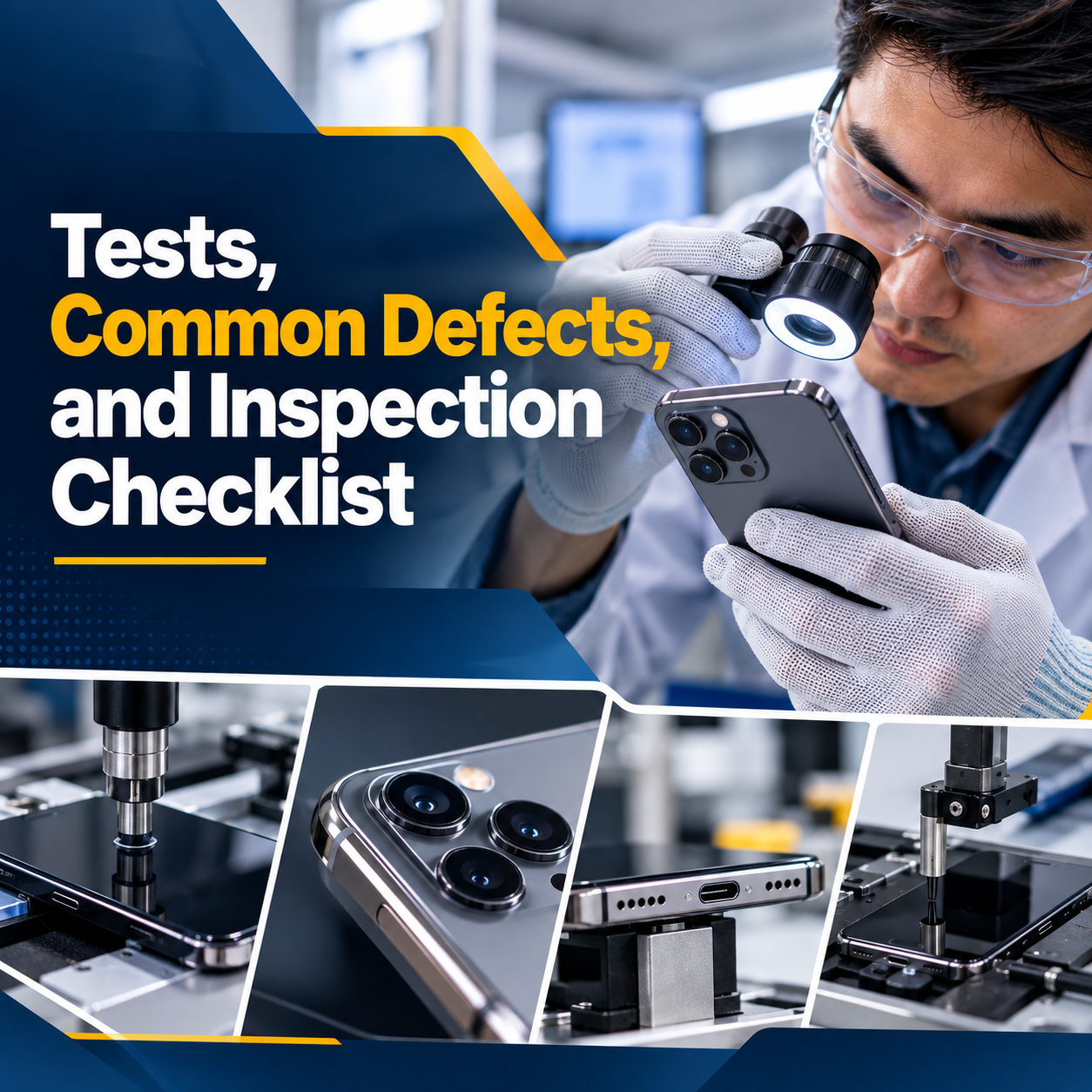
A smartphone packs a display module, a printed circuit board assembly (PCBA), several cameras, radios, sensors, and a lithium-ion battery into a sealed enclosure. A defect in any one of them can turn into a return, a safety incident, or a customs hold.
An inspection therefore checks five areas:
Third-party quality inspection services do this work at the factory so the buyer sees real units, not samples hand-picked for approval. Many of the same principles apply to other connected devices, and teams that already inspect a smartwatch will recognize the overlap in battery, display, and sensor checks.
A single final check catches problems too late to fix cheaply. Smartphone programs usually layer inspections across four stages.
Displays, batteries, camera modules, and housings are checked as they arrive at the assembly plant. Catching a bad batch of panels here prevents thousands of assembled phones from needing rework.
Run once the first few hundred units come off the line. Inspectors compare early units with the approved golden sample for firmware build, color, fit, and function, and confirm the line follows the agreed process.
Typically done when 20% to 60% of the order is complete. This stage surfaces drift such as rising touch failures or a camera module from a second-source supplier behaving differently.
Done when at least 80% of the order is finished and packed. The lot is sampled at random, units are tested, and the result decides whether the shipment is released.
For new models, add a first article review and a process audit of the SMT and final assembly lines before mass production starts.
An inspector can only pass or fail against a written requirement. These are the references that most often define smartphone acceptance criteria.
| Area | Reference | What it governs |
|---|---|---|
| Sampling | ISO 2859-1 (equivalent to ANSI/ASQ Z1.4) | Sample size and accept/reject numbers |
| PCBA workmanship | IPC-A-610 and IPC J-STD-001 | Solder joint and assembly acceptability |
| ESD control | ANSI/ESD S20.20, IEC 61340-5-1 | Handling and workstation controls |
| ESD immunity | IEC 61000-4-2 | Device tolerance to electrostatic discharge |
| Product safety | IEC 62368-1 | Safety of audio, video, and ICT equipment |
| Battery safety | IEC 62133-2 | Lithium cell and battery safety |
| Battery transport | UN 38.3 | Tests required before lithium batteries ship |
| Ingress protection | IEC 60529 | Meaning and testing of IP ratings |
| RF exposure (US) | FCC SAR limit | 1.6 W/kg averaged over 1 g of tissue |
| RF exposure (EU) | EN 50360 / Council Recommendation 1999/519/EC | 2.0 W/kg averaged over 10 g (head and trunk) |
| Hazardous substances | EU RoHS 2011/65/EU, REACH, China RoHS | Restricted substances and declarations |
| EU charging | Directive (EU) 2022/2380 | USB-C receptacle required for new phones since December 28, 2024 |
Smartphones sold in the EU face durability requirements that inspection teams must account for. Regulation (EU) 2023/1670 came into force on 20 September 2023 and its provisions apply from 20 June 2025. Among its requirements, phones must show greater resistance to drops, scratches, dust and water, and use batteries capable of at least 800 charge cycles while retaining at least 80% of their initial capacity. The companion energy label under Regulation (EU) 2023/1669 also discloses battery endurance, drop resistance, and repairability.
For inspection, this means the buyer should request the supplier’s ecodesign test reports for the exact model and confirm the energy label printed on the box matches the registered product data.
Functional tests are done on powered units, ideally with a test script so every inspector runs the same sequence. Compare results against the golden sample, not against memory.
Software problems often pass visual checks entirely. A structured approach to firmware and functional testing helps define what “correct build” means before the inspector arrives.
Reliability tests are mostly destructive or time-consuming, so they are not run on the inspection sample itself. Instead, the inspector verifies that valid lab reports exist for the current build, witnesses selected tests, and pulls separate units for any on-site checks.
| Test | Typical location | What the inspector verifies |
|---|---|---|
| Drop and tumble | Lab or factory reliability room | Report covers current housing and glass supplier |
| IP water and dust (IEC 60529) | Accredited lab | Rating on packaging matches the test result |
| Button and port cycle life | Factory reliability room | Cycle counts meet the specification |
| Thermal cycling and humidity | Lab | No functional loss after exposure |
| Battery safety (IEC 62133-2) | Certified lab | Report matches the cell supplier and model |
| UN 38.3 transport | Certified lab | Test summary available for the shipment |
| ESD immunity (IEC 61000-4-2) | EMC lab | No reset or damage at the specified levels |
| SAR and RF | Accredited RF lab | FCC ID or CE documentation matches the model |
A frequent gap is a report that is valid for the original battery cell or glass supplier but not for a second source added later. Ask the factory to confirm, in writing, which component suppliers each report covers. Broader approaches to thermal and environmental testing explain how to set test conditions when writing these requirements.
Defects cluster around a predictable set of components. Knowing where to look shortens the inspection and improves detection.
Many intermittent faults trace back to the reflow process, and the root causes are covered in detail in this guide to common soldering defects.
Every defect found must be assigned to a class before the AQL decision is made. Agree on this classification with the supplier in writing before production, ideally in the quality agreement or inspection plan.
| Class | Definition | Smartphone examples |
|---|---|---|
| Critical | Could cause injury, violate law, or make the product unsafe | Swollen battery, overheating, exposed sharp edge, missing mandatory safety or regulatory marks, IMEI mismatch |
| Major | Likely to cause failure or a return | Dead pixel in the main viewing area, touch dead zone, camera focus failure, no SIM detection, wrong firmware |
| Minor | Unlikely to reduce use but departs from the specification | Small scratch on a secondary surface within limit, slightly skewed label, light carton scuff |
Cosmetic decisions are only consistent when everyone looks the same way. Buyer specifications usually divide the phone into zones (Zone A for the display and front face, Zone B for the back and sides, Zone C for areas hidden in normal use) and set allowed defect size and count per zone. They also fix the viewing distance, light level, and seconds per surface. Without these written conditions, two inspectors can reach different results on the same unit.
When a lot fails, the findings should feed a formal non-conformance report so the supplier’s corrective action can be tracked to closure instead of handled as a one-off sort.
Inspecting every phone in a large order is rarely practical. ISO 2859-1 sampling gives a statistically defensible way to accept or reject a lot from a sample.
A shipment of 5,000 phones under General Level II uses code letter L, which means a sample of 200 units under single normal sampling.
| Defect class | AQL | Accept | Reject |
|---|---|---|---|
| Critical | 0 | 0 | 1 |
| Major | 1.0 | 5 | 6 |
| Minor | 2.5 | 10 | 11 |
If the inspector finds six major defects in the 200 units, the lot fails, even if critical and minor counts are within limits.
A full functional script can take many minutes per phone. Many buyers therefore run cosmetic and packaging checks at General Level II and full functional tests at Special Level S-4. For the same 5,000-unit lot, S-4 gives code letter G, a sample of 32 units. Whatever split you choose, write it into the inspection plan so the result cannot be disputed later.
Use this as the base for a model-specific checklist. Add the buyer’s tolerances, golden sample references, and photos of acceptable and rejectable defects.
Even a well-written checklist can fail when the inspection setup around it is flawed. These are the gaps that most often let defective phones pass and reach end users.
When the design changes and the golden sample does not, inspectors either fail good units or pass bad ones. Re-approve the sample after every engineering change.
Factories often add a second source for glass, batteries, or camera modules when supply is tight. Without notification, the lab reports in the file no longer describe the product being shipped.
Phones damaged by static on the line may pass final tests and fail weeks later in the field. Practical steps for preventing ESD damage belong in the factory audit, not just the design review.
A pre-shipment inspection tells you about one lot. Recurring defects need a look at the SMT line, assembly stations, and test fixtures, which is where supplier audits find the causes that sampling cannot.
Units must be pulled at random by the inspector from across the lot. A sample chosen by the supplier is a demonstration, not an inspection.
Inspection effort is usually quoted in inspector man-days. The time depends on the sample size, the length of the functional script, and how many models or colors are in the order. Complex flagship models with many cameras and radios need more time per unit than basic feature phones, so share the test script when requesting a quote.
Function tests require opening the box and powering on the unit. Agree in advance whether the factory will reseal opened boxes with new shrink wrap or seals, and whether opened units should be flagged for internal use. Some buyers keep sealed units untouched and test only from a separate pulled sample.
No. CE, FCC, battery, and SAR certification require accredited lab testing on the design. Inspection confirms that the units being shipped match the certified design and that the documentation is valid for the current components.
Refurbished phones need battery state-of-health readings, checks that replaced parts are not flagged by the operating system as unknown, confirmation that activation locks and previous accounts are removed, and verification that the IMEI is not blacklisted in the destination market.
The supplier normally sorts or reworks the lot, then a re-inspection is done on a fresh sample. The buyer should require a root cause and corrective action so the same failure does not repeat on the next order.
AMREP has supported OEMs and product innovators for more than 35 years, with inspectors and quality engineers on the ground across Asia, the Americas, and Europe, including China, Vietnam, India, Thailand, Malaysia, Indonesia, the Philippines, and Mexico. Our teams study your specification and golden sample before inspecting, so test scripts and cosmetic limits match what you actually approved.
Beyond pre-shipment checks, AMREP’s electronics quality specialists audit SMT and assembly lines, follow up on corrective actions, and place resident engineers at your supplier’s site when a program needs daily oversight. Contact AMREP to set up a smartphone inspection plan for your next production run.
Contact Us To See What We Can Do
Call Us
Mon - Sat 9.00 - 18.00
Sunday Closed


12 - May 2025
12
May
2025
Malaysia is a premier manufacturing hub in Southeast Asia. According to the Malaysian Investment Development Authority (MIDA), “Malaysia, with its extensive trade....

22 - April 2025
22
April
2025
Healthcare is rapidly evolving, ensuring consistent and high-quality patient care. Total Quality Management (TQM) in healthcare is more than just a buzzword—it is a powerful....

16 - April 2025
16
April
2025
Total Quality Management (TQM) is a mindset that involves everyone in the organization working toward a common goal: achieving excellence through quality. From....


Our website uses cookies to improve your experience. Read our Cookie Policy for more information.