Guide to Qualifying New Suppliers in Malaysia for Manufacturing Success
Malaysia is a premier manufacturing hub in Southeast Asia. According to the Malaysian Investment Development Authority (MIDA), “Malaysia, with its extensive trade....

By AMREP | Posted on November 16, 2026
Published: November 16, 2026 | Last reviewed: November 16, 2026
A pre-shipment inspection checklist is the set of checks an inspector runs on finished, packed goods before they leave the factory. It covers quantity, packing, labels, workmanship, specifications, on-site function and safety tests, and the compliance documents your destination market requires. Results are judged against AQL limits you set in advance, so the inspection ends with a clear pass, fail or hold decision before you release final payment.
This guide covers how pre-shipment inspection works, how to prepare for it, how AQL sampling sets your sample size, the full checklist section by section, how to act on a failed report, and the mistakes that let problems slip through.
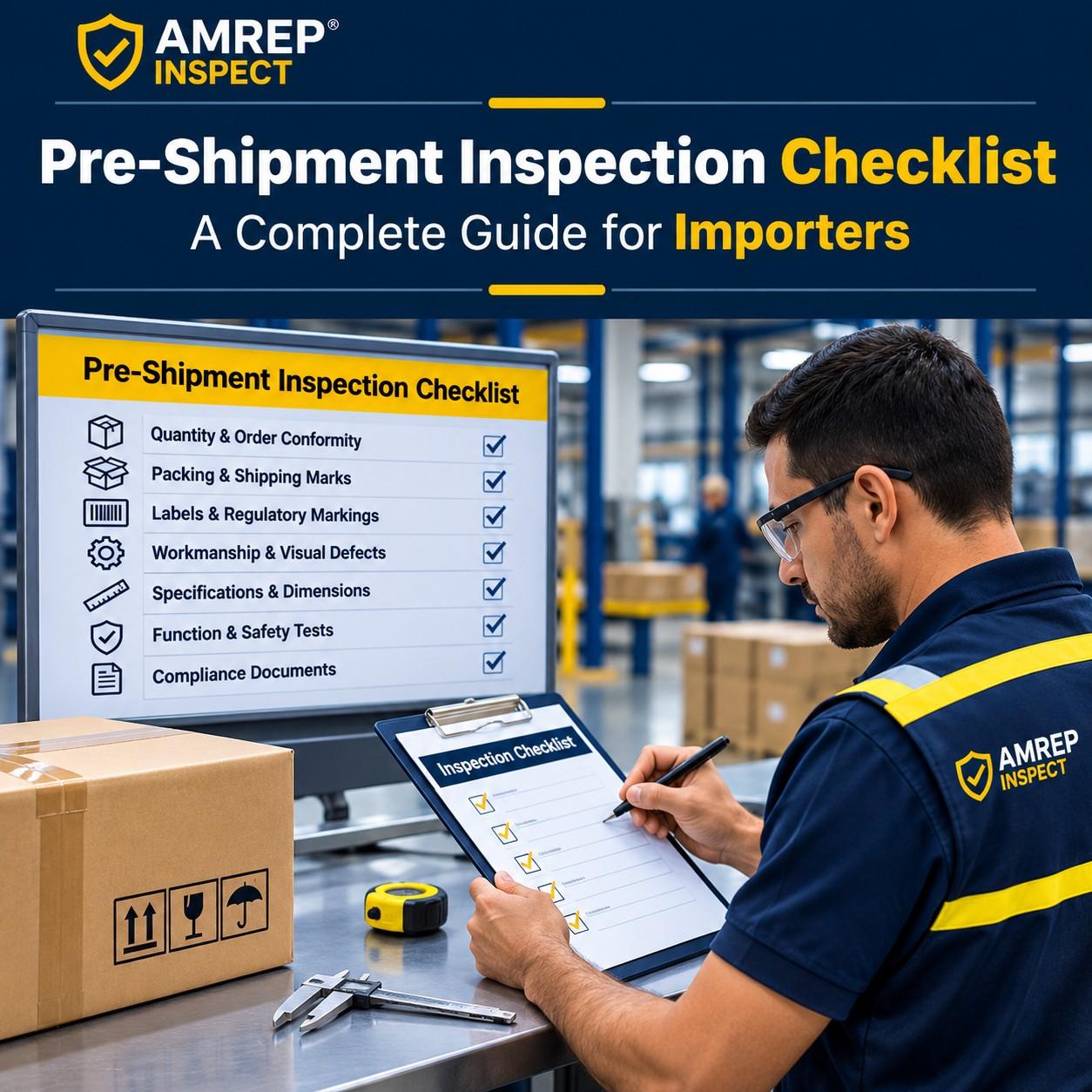
A pre-shipment inspection is usually performed when production is at least 80% complete and the goods are packed. It uses a statistical sample, often based on an AQL plan, to assess the quality of a representative portion of the shipment.
Booked too early, the inspector checks loose units instead of packed cartons and cannot confirm shipping marks, carton counts or final packing. Booked too late, there is no time to rework or sort before the vessel cutoff. Ask the factory for a packing list showing finished and packed quantities a few days before the visit, and confirm readiness the day before.
The term covers two different things. Some importing countries require a government-mandated PSI, carried out by an appointed agency to verify price, quantity or customs classification before goods clear. The WTO Agreement on Pre-Shipment Inspection governs those programs. This guide covers the commercial kind: a quality inspection the buyer appoints to confirm the goods match the order before final payment.
A pre-shipment inspection is the last chance to stop a bad shipment, but it is not the only control available.
| Inspection | Typical timing | What it catches |
|---|---|---|
| Initial production inspection | 0 to 20% of production complete | Wrong materials, components or setup before volume production |
| During production inspection | Typically 20 to 80% complete | Workmanship and process problems while there is time to correct them |
| Pre-shipment inspection | At least 80% complete and packed | Defects, packing, labeling and quantity issues in the finished lot |
| Container loading supervision | During loading | Short shipments, product swaps and poor stowage |
Importers usually choose between three options, and the choice affects how much you can trust the report.
Whichever you choose, check four things: independence from the factory, a local presence near your suppliers, experience with your product category, and reports that show photos and actual readings rather than ticked boxes. Ask whether the inspector will work from your own pre-shipment inspection checklist, not a generic template.
An inspector can only check what you define. Send these to the inspection company before the visit, and copy the factory so there are no surprises on the day.
AQL sampling comes from ISO 2859-1. The current edition is ISO 2859-1:2026, the third edition, which introduces skip-lot sampling procedures, updated guidance for applying sampling strategies, and replaces the previous edition from 1999 along with its amendments. ANSI/ASQ Z1.4 is the closely aligned standard widely used in the United States. If your supplier contracts still cite the 1999 edition, update them at the next revision.
AQL stands for acceptance quality limit, and it does not mean the share of defects allowed in your shipment. The standard's purpose is to incentivize the producer through the economic and psychological pressure of lot non-acceptance to maintain a process average at least as good as the specified acceptance quality limit, while providing an upper limit for the risk to the consumer of accepting the occasional poor lot. A lot inspected at AQL 2.5 can still contain more than 2.5% defective units.
Three inspection levels, I, II and III, are given for general use, and normally Inspection Level II is used. Special levels S-1 to S-4 use much smaller samples and suit destructive or slow tests, such as a carton drop or a seam strength check.
Here is how the tables work in practice. For a production of 4,000 units inspected at Level II normal inspection, the lot size and inspection level give sample size code letter L, which indicates a required sample size of 200 units.
| Defect class | Typical AQL | Accept if defects found are at most | Reject if defects found reach |
|---|---|---|---|
| Critical | Zero tolerance | 0 | 1 |
| Major | 2.5 | 10 | 11 |
| Minor | 4.0 | 14 | 15 |
Zero tolerance for critical defects, 2.5 for major and 4.0 for minor is a common starting point for consumer goods. Tighten the major and minor limits for medical, electrical or premium products. For more on reading the tables, see this guide to AQL sampling under ISO 2859.
The AQL result covers only the visual and dimensional defects found in the main sample. Quantity, packing, labeling, on-site tests and documents are judged separately. A shipment with an AQL pass can still fail overall because of wrong shipping marks, a failed drop test or a missing warning label.
Each section of the pre-shipment inspection checklist below follows the order inspectors usually work in on site. Adapt the detail to your product, but keep every section.
Inspect every unit in the AQL sample against the golden sample and classify each defect.
| Product category | Critical example | Major example | Minor example |
|---|---|---|---|
| Electronics | Exposed live part | Product does not power on | Light scratch on base |
| Apparel | Loose snap on a children's garment | Broken zipper | Untrimmed thread |
| Furniture | Unstable when loaded | Missing hardware | Small finish mark on underside |
| Toys | Detachable small part | Mechanism does not work | Slight color variation |
Photograph each defect with its classification, so you can judge borderline calls yourself.
Specify each test and its sample size in advance. Special inspection levels are usually enough for destructive or slow tests.
| Product category | Typical on-site checks |
|---|---|
| Electrical and electronics | Full function test, dielectric (hi-pot) test, earth continuity, cord pull |
| Apparel and textiles | Garment measurements, seam and snap pull tests for children's wear, color fastness rub test |
| Furniture | Assembly from the retail package, stability, load and fit of parts |
| Toys and children's products | Small parts check, sharp point and edge checks, function |
| Housewares and hardlines | Function and fit, drop test, stability, coating adhesion |
On-site tests confirm consistency across the production lot. They do not replace laboratory testing to your market's safety standards.
The inspector should confirm that test reports match the product, materials and factory actually being shipped.
A failed report is a decision point, not an automatic rejection. Choose based on the type of defect, the ship date and the cost of each option.
Write the consequences into your purchase contract before production starts: who pays for re-inspection, how much time the factory has to rework, and whether final payment depends on a passed inspection.
For regional considerations when sourcing from Vietnam, Thailand, Malaysia or the Philippines, see this overview of pre-shipment inspections in Southeast Asia.
A failed shipment found at your warehouse costs far more than one found at the factory, where rework is still possible, and the final payment is still yours. AMREP Supplier Management Services has inspected goods at supplier sites since 1983, with inspectors across Asia-Pacific, Mexico and Europe. Its quality inspection services cover every stage from pre-production to pre-shipment, judged against your own checklist and AQL limits. Contact AMREP Inspect to book your next pre-shipment inspection.
Pre-shipment inspections are usually priced per inspector-day, plus travel for remote factories and any extra tests or laboratory work. The main cost drivers are the sample size, the number of products on the order, the on-site tests required and the factory's location. Ask for a quote based on your actual order details rather than a flat rate.
It depends on the sample size, the number of on-site tests, and how many products are on the order. Many single-product inspections fit within one inspector-day. Orders with several items, large samples or long tests may need more time or a second inspector.
Sometimes. Video-based inspections are emerging as a model for lower-risk or repeat items. For new products, new suppliers or anything with safety requirements, an inspector on site is still the safer choice, because video limits measurements, tests and random carton selection.
No. An inspection report records what an inspector found in a sample of your lot. For US children's products, passing test reports do not satisfy the certificate requirements either: the passing report from a CPSC-accepted third-party laboratory is the foundation for the CPC, but it is not the CPC itself. An importer also cannot simply pass along a foreign manufacturer's certificate, although it may rely on another party's testing to create a CPC if it exercises due care and has access to the underlying test reports.
Yes. ISO 2859-1 includes switching rules that monitor inspection results over time, moving a supplier from normal to tightened inspection after poor results and back once quality recovers. You can also raise the inspection level or lower the AQL limits for major and minor defects. Write the approach into your quality agreement so the supplier knows in advance.
No. Sampling means some defective units can pass unnoticed, especially at higher AQL limits. A passed inspection means the lot met the limits you set. For zero-defect requirements on critical features, ask for 100% inspection of that feature or for production-stage controls at the factory.
Contact Us To See What We Can Do
Call Us
Mon - Sat 9.00 - 18.00
Sunday Closed

12 - May 2025
12
May
2025
Malaysia is a premier manufacturing hub in Southeast Asia. According to the Malaysian Investment Development Authority (MIDA), “Malaysia, with its extensive trade....

22 - April 2025
22
April
2025
Healthcare is rapidly evolving, ensuring consistent and high-quality patient care. Total Quality Management (TQM) in healthcare is more than just a buzzword—it is a powerful....
16 - April 2025
16
April
2025
Total Quality Management (TQM) is a mindset that involves everyone in the organization working toward a common goal: achieving excellence through quality. From....


Our website uses cookies to improve your experience. Read our Cookie Policy for more information.